Remember When? – MacKinnon and Son Dry Goods
by Maralyn Fink

I remember this store back in my day located next to the Hick’s Clothing Store. What I thought was neat is that it had a stairway leading up to partial second floor. I wondered if they would let me slide down that banister. My mother said don’t even try it. Where was her sense of humor?

The store sold women’s clothing, dresses, blouses, skirts etc and probably some under things. Material for the sewers around was a delight for them to shop.
 Edward and Fraser MacKinnon
I remember Fraser MacKinnon who was well liked and always greeted his customers when they came in.
My mother purchased clothing there for herself and probably my sister and me. I was still buying there in the middle 60s to into the 70s.
It is sad for me to think back to the day and compare it to what we have now. I only wish that everyone would have had the chance to really experience that period and hold it dear as I still do.
Today the store is Nicole’s Beauty Salon and Spa and the character inside remains as it was Back In The Day.

This week’s Mystery Photo
Where is this?

Can you tell us where this is located? Drop us a line at mail@sjindy.com.
109 S. Oakland St.

The current owners are George and Mary Enochs. The previous owner was Doris Enochs.
A Look Back – St. Johns Jaycettes Raised Funds
by Barry Bauer
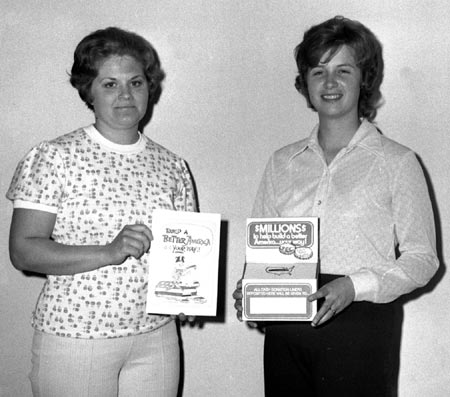
Janet Scott, St Johns Jaycettes president, and Diana Woodbury, Crown for a Better America project chairman, display the posters and canisters to be used in the project to raise funds for Kidney Foundation of Michigan.
St Johns Jaycettes, as well as Jaycettes organizations throughout Michigan, will be raising funds by Collecting Royal Crown Cola and Diet-Rite Cola caps with special liners. Those with special liners are then turned into the company for a cash donation. The campaign will continue through Dec 31, 1973, and more information about the campaign will be available next week.
Janet and her husband, Dennis, used to own the Western Auto Store in downtown St. Johns; and Diana and her husband, Wayne, currently own Woodbury’s Flower Shop downtown.
Benny and Jessie’s Pet Info – Your Dog and the Cold Germ
Can My Dog Catch a Cold?
Winter isn’t the only time of year we have to worry about “catching” a cold, but it is the primary time for it. We’re spending more time in closed quarters, with windows and doors shut tight and no way to escape the germs. It is only a matter of time before someone in the house becomes sick. It could be you, but did you know that it could also be your dog that comes down with this common respiratory infection?
While there are differences in the types of viruses that infect humans versus dogs, the symptoms are basically the same: sneezing, coughing, runny or stuffy nose, watery eyes. What can you do to protect your dog from catching cold, or if your dog does come down with a case of the cold, what can you do to treat it?
Different Germs, Different Viruses
As mentioned above, the type of cold a dog suffers from is different from the type a human suffers from. The illness is not communicable between species — at least, one has not yet been discovered — so there is no need to worry about catching your dog’s cold, or vice versa.
You will need to differentiate a common cold from a more serious health issue. For example, a common cause of dry cough is a condition known as “kennel cough.” This contagious type of cough, as its name suggests, is typically contracted through a kennel or boarding facility. This cough is most easily recognized by its characteristic honking sound. If your dog has recently been boarded or has had contact with a dog that has been boarded recently, this will need to be considered, and will need to be treated by a veterinarian.
There are other highly contagious, cold-like illnesses to be familiar with, as well. The influenza virus, parainfluenza virus, adenovirus, and tuberculosis are all illnesses that can be transmitted by infected dogs.
Another potentially life-endangering viral illness is canine distemper. A dog exhibiting symptoms of distemper will usually have coughing, vomiting, high fever, and a thick discharge from the eyes and nose.
When a Cold is Not a Germ or a Virus
There are several types of parasites that can get into the lungs, heart and trachea, and which can also cause symptoms that mimic a cold infection. Coughing and other breathing problems are the main symptoms. Fungal infections are also commonly found in dogs, and can sometimes lead to life threatening conditions, when the fungal parasite sets up house in the lungs, causing ongoing, repetitive coughing, scarring of the lung tissue, and eventually, in some cases, pneumonia.
More difficult to distinguish in many instances, but just as common in animals as in humans, are allergies to environmental triggers and/or food products. An undiagnosed asthma or allergies that trigger respiratory symptoms can also bring on coughing and sneezing fits in dogs.
How to Care for a Pet with a Cold
If your dog is coughing or sneezing, but is in otherwise good health, you may be able to treat the condition as you would a simple human cold — with lots of liquids, healthy foods (Chicken soup, even? But of course! Just make sure to leave out the bones.), warmth, and maybe even some time in a warm and humid room. This can be done by placing a humidifier near his rest area or by filling the bathtub with steaming water and letting the dog hang out in the bathroom for a bit (not in the water), just to let the steam loosen up his sinuses and lungs.
It is important to note that while most respiratory conditions will begin to improve within several days from the time of onset, some dogs’ immune systems are not as prepared for an infection and may need a course of antibiotics or other medications in order to fully recover.
If your dog is either very young or very old, it is best to have her looked over by your veterinarian, since dogs at either end of the age scale tend to have less capable immune systems and can suffer more as a result.
You can help to prevent a cold by keeping her indoors during cold, wet weather, with just brief trips outside for relief. It isn’t the cold temperature that creates the illness, of course, but over exposure to unfriendly temperatures or environments can create a physical situation that makes it easier for a bacterial or viral germ to latch on and take hold in the body. And making sure the physical body is at its healthiest is the main preventative for a host of diseases, not just the cold. Provide your dog with plenty of fresh water — even if there is water still in the bowl, make sure to change it out at least once a day, ideally with a clean bowl every day — and healthy foods so that your dog’s immune system can keep up with whatever germs come his way, and so that he has the strength to exercise at a level that is normal for his age and breed. If your dog is of a breed that typically has respiratory challenges, your veterinarian may suggest keeping a humidifier in your dog’s rest area as a matter of course.
Finally, it can be challenging enough to have one pet who is as “sick as a dog;” you certainly don’t want a house-full of them. While your dog is ill, make sure she is separated from the other dogs in the house so that the infection is not passed along, and if symptoms don’t improve or appear to worsen, consult with your veterinarian.
Maralyn’s Did You Know? – Big Dog Natural Recalls
Big Dog Natural of Brick, NJ is voluntary recalling a select production lot of Big Dog Natural raw dehydrated dog food Chicken Supreme potentially contaminated with Salmonella and Fish Supreme potentially contaminated with Listeria monocytogenes that was shipped in the week of 10/31/2015 to 11/13/2015 to online customers. Salmonella and Listeria monocytogenes can affect animals eating the products and there is risk to humans from handling contaminated pet products, especially if they have not thoroughly washed their hands after having contact with the products or any surfaces exposed to these products.
Healthy people infected with Salmonella and Listeria monocytogenes should monitor themselves for some or all of the following symptoms: nausea, vomiting, diarrhea or bloody diarrhea, abdominal cramping and fever. Rarely, Salmonella and Listeria monocytogenes can result in more serious ailments, including arterial infections, endocarditis, arthritis, muscle pain, eye irritation, and urinary tract symptoms. Consumers exhibiting these signs after having contact with this product should contact their healthcare providers.
Pets with Salmonella and Listeria monocytogenes infections may be lethargic and have diarrhea or bloody diarrhea, fever, and vomiting. Some pets will have only decreased appetite, fever and abdominal pain. Infected but otherwise healthy pets can be carriers and infect other animals or humans. If your pet has consumed the recalled product and has these symptoms, please contact your veterinarian.
These products were sold directly to consumers through the company’s online website and in the US. The voluntarily recalled product include all weight volumes of the Big Dog Natural Chicken and Fish Supreme. No additional products are affected by this recall.
Big Dog Natural became aware of a potential issue after receiving notification from the FDA that an investigational sample of Chicken Supreme tested positive for Salmonella and an investigational sample of Fish Supreme for Listeria monocytogenes.
Consumers should discontinue feeding the affected product and monitor their pet’s health, and contact their veterinarian if they have concerns. Consumers who purchased the product can obtain a full refund or exchange by returning the product in its original packaging.
Consumers with questions should contact Big Dog Natural https://www.bigdognatural.comdisclaimer icon or by calling 1-732-785-2600 (from 9am till 4pm EST).
Maralyn’s Pet Corner – How to Walk Your Cat (and Live to Tell About It)
Ever seen a cat out walking on a leash? Most people who have seen one react with astonishment that a cat would be domesticated enough to willingly allow itself to be tethered to a leash and guided around by — of all things! — a human companion. But it can, and does happen. After all, why should dogs have all the fun? Everyone knows cats like the outdoors, too. Shouldn’t they get the opportunity to explore the great outdoors along with the rest of us? Shouldn’t they be allowed to maintain their youthful figures with some regular exercise? With proper supervision, patience, and consistency, you too can train your cat to walk on a leash.
Does Age Matter?
Once a cat has reached the age when she has been fully vaccinated, it is safe for her to go outside. Remember that this is not so much to protect other animals from what she might be carrying, but to protect her from what they might be carrying. It is best to start as early as possible, before your cat has developed a fear of the outdoors or a fear of unusual noises. Older cats are often more reluctant to go outside on a leash — or to be on a leash at all. It may take months to get her used to accepting a harness, and to being led, but with diligence and a wish to succeed, you can do it.
It will help a lot of your cat is already responsive to you. If you can call your cat and she consistently comes to you, you are already on a good track. If you do not have this type of relationship, you will need to start there. Using treats and lots of praise, call your cat to come to you. After some time, your cat will learn that coming when called will be rewarding.
Selecting the Proper Harness
Because cats are so agile, a simple collar around the neck is not enough to hold them — they can easily pull out of the neck collar, even a well fitted one (and you do not want to make the collar so tight that there is a potential of cutting off air flow). Instead, use a good-quality harness that has been designed especially for cats.
A cat harness is typically made with an adjustable neck collar, which is attached to an adjustable body wrap. The harness should fit snug to the body, but not be so tight that air flow will be constricted. You should be able to fit two fingers under the harness at the neck and under the chest.
Depending on the harness, the leash should attach at the body strap or between the shoulders instead of at the neck. The clips holding the harness should snap securely — they should not be the break away type that is commonly found in cat collars.
Introducing the Harness
It may take some time before your cat gets used to wearing a harness, so start slowly. Set the new harness near your cat’s favorite area and allow her to see it, smell it, and even play with it at first. Offer her some treats and praise if he shows interest in the harness.
After a few days of this, hold your cat securely and give him a treat. As he’s eating the treat, drape the harness loosely over him and leave it for a few minutes. You may need to repeat this several times before actually adjusting it, just to get your cat used to the feel of the harness. Once she appears to be comfortable with having the harness on his body, put the harness on and tighten the straps so they fit snugly. Again, offer positive reinforcement and treats for allowing you to put the harness on her. Leave the harness on for a short period of time, a few minutes to start, with gradually more time.
Do not force the fitting. If your cat struggles too much, remove the harness and try again later. When she does accept the harness without struggle, give him lots of attention so that he associates wearing the harness with good times.
Add a Leash
Once your cat is accepting the harness, let her wear it around the house, doing her normal activities. Gradually increase the amount of time your cat is left in the harness. You can even feeding her while she’s wearing the harness. Next, attach the leash to the harness, allowing her to drag the leash around. This is to get her used to the weight of the leash, but remember to keep an eye on her while she is dragging the leash. You don’t want her to get it tangled up on anything.
You can then graduate to walking around inside while holding the leash. Don’t pull on the leash and don’t try to force her to follow you at first, follow her lead instead. Every now and then stop and call her to you, giving her a treat and praise when she comes.
Finally, when she seems comfortable on the leash indoors, it is time to go outdoors. Begin with a short trip outside, maybe just as far as outside the door where your cat can sniff around and start getting used to the sounds and scents. After doing this a few times, you might take a short stroll around the block. Before you go any farther than the immediate area, get to know your neighborhood to make sure that your neighbors do not allow their dogs to roam freely — or so that you know which areas to avoid because of roaming dogs. Choose the quietest and safest areas for your cat to walk in, so that the experience is pleasurable for both of you.
Tips for Safe Walking
Although your cat’s usual collar does not need to be removed, it is not part of the harness system. However you should leave the collar on, with its ID in place, just in case your cat gets loose while you are out.
For the first few walks, as your cat is getting used to being outside, you might want to take along a soft (or hard) carrier, just in case your cat has a panic attack, or in case you unexpectedly come up against a free roaming dog. A panicked or threatened cat is not going to want to be held in arms until it gets home.
This will work best if your cat has been spayed or neutered. An unneutered male cat may be more likely to try to escape the harness or get out of control while outside, and an unspayed female cat may be attacked by feral male cats.
Setting a regular time to walk each day will give your cat something to look forward to. Try to stay consistent.
Unlike dogs, cats cannot be tethered to a pole while you step into a shop, even for just a few minutes. Your cat might panic and get itself tangled in the leash, or it may be attacked by a dog and not be able to escape.