This week’s Mystery Photo
Where is this?

Can you tell us where this is located? Drop us a line at mail@sjindy.com.
601 S. Oakland St.

The current owner is Heather Gilson Theis. Previous owners include Muriel Gilson and Ken Gilson. In 1950 Robert T. Palmer lived here.
Don and Muriel Gilson lived here for many years before their deaths.
A Look Back – The Refrigerator
by Barry Bauer
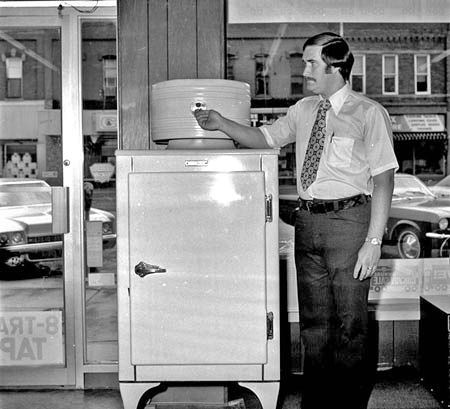
Do you remember a refrigerator like this? I don’t either. Rich Snyder, who at that time was working at Kurt’s Appliance, shows off this beauty in 1974.
Early refrigerators had the refrigeration unit mounted on top of the refrigerator instead of down below like today’s refrigerators. This refrigerator was built sometime in the 1920s.
Kurt’s has a collection of old time appliances in the basement.
Benny and Jessie’s Pet Info – Your Dog’s Nose is Even More Powerful Than You Think
I love to go on walks with my dogs, but they and I have very different ideas about what the point of a walk should be. I am out for exercise with a side of sunshine and fresh air. Apollo’s goal is to smell… absolutely everything! This leads to conflict. I want to keep moving and Apollo wants to stop, and then walk, and then stop, and then walk.
We all know that a dog’s sense of smell is better than our own, but do you know just how much better? I recently watched a TED-Ed Lesson that starts with an excellent explanation of just how a dog’s nose works:
As your dog catches the first hints of fresh air, her nose’s moist, spongy outside helps capture any scents the breeze carries. The ability to smell separately with each nostril, smelling in stereo, helps to determine the direction of the smell’s source so that within the first few moments of sniffing, the dog starts to become aware of not just what kind of things are out there but also where they’re located.
As air enters the nose, a small fold of tissue divides it into two separate flows, one for breathing and one just for smelling. This second airflow enters a region filled with highly specialized olfactory receptor cells, several hundred millions (300,000,000) of them, compared to our five million. And unlike our clumsy way of breathing in and out through the same passage, dogs exhale through slits at the side of their nose, creating swirls of air that help draw in new odor molecules and allow odor concentration to build up over multiple sniffs.
But all that impressive nasal architecture wouldn’t be much help without something to process the loads of information the nose scoops up. And it turns out that the olfactory system dedicated to processing smells takes up many times more relative brain area in dogs than in humans. All of this allows dogs to distinguish and remember a staggering variety of specific scents at concentrations up to 100 million times less than what our noses can detect. If you can smell a spritz of perfume in a small room, a dog would have no trouble smelling it in an enclosed stadium and distinguishing its ingredients, to boot.
The video goes on to talk about how our sense of sight and hearing present us with a picture of a single moment in time, while a dog can smell “an entire story from start to finish.” It also explains how the canine vomeronasal organ lets dogs “identify potential mates, distinguish between friendly and hostile animals, and alerts them to our various emotional states. It can even tell them when someone is pregnant or sick.”
I had reached what I thought was a pretty good compromise with Apollo on our walks. He got to dawdle at the beginning, but at all other times he was expected to get his nose off the ground and keep up the pace. Now, I think I’ll give him a few more opportunities to stop and smell the roses, so to speak.
Take a look at this TED-Ed Lesson; it will give you a new appreciation for what your dog can do with his nose. http://ed.ted.com/lessons/how-do-dogs-see-with-their-noses-alexandra-horowitz#watch
Maralyn’s Pet Corner – Helping Homeless Cats Through the Winter
Street cats, alley cats, wild cats, feral cats, homeless cats … there are a lot of different names we give to these free ranging felines. Most of the time, they take care of themselves, scavenging and hunting for their meals while also depending on the kindnesses of cat lovers, but things can get a lot chancier when the weather turns frigid.
Before we go on, let’s consider why you might want to help your neighborhood’s feral cats. In any neighborhood that supports a healthy (i.e, neutered and released) feral cat population, rodent populations are kept in check, eliminating the need for harmful chemicals and poisons, and protecting the residents of these neighborhoods from the diseases and damage rodents can cause to life and property. Cats are a practical and “green” solution to this universal problem. In addition, a family and neighborhood commitment to caring for a controlled feral cat population teaches our children that we respect life and appreciate the work these cats do for us.
This is why many animal supporters encourage community participation in maintaining their local feral cat population. If you count yourself amongst these supporters, there are ways you can help your local cats to get through the winter with a minimum of hardship. If you can get your neighbors involved, so much the better.
Providing Shelter
Cats don’t need a lot of space, just a space that is large enough for them to stand and move about and stay safe from the harshest outdoor elements. When the weather is at its coldest, the cats will be relying on each other for warmth, and will create their own tight spaces within their shelter. With that in mind, you can use whatever space and materials available to you to create a small haven.
Homemade shelters can be crafted out of nearly anything: from a sturdy cardboard box (think of the heavy cardboard used for packing television sets) to an anchored plastic garbage can to a few pieces of scrap wood that have been arranged as a buffer against the wind and snow and rain. The shelter should be large enough to accommodate several cats comfortably, but not too wide or tall. In fact, the smaller the size, the better the space will be equipped to retain the cats’ body heat.
When creating the entry opening into the shelter, keep in mind that the opening should only be large enough to allow a cat to enter, so that as much of the wind and snow stay outside of the shelter as possible and the interior of the shelter remains dry. If space allows, you can create an awning or plastic “curtain” to shield the entry. Plastic sheeting or heavy garbage bags are quick and inexpensive options for this. If it is not possible to cover the opening, you can try placing the shelter close to a wall, with the entry facing the wall.
If you are able to put a little more work and material into the shelter, try adding insulation to the interior roof and walls of the structure and line the seams of the shelter with caulk so that it is as draft free as possible. Also, elevate the shelter off of the ground to prevent ground moisture from seeping into the floor of the shelter. Of course, you do not want the shelter to be entirely sealed. Some amount of ventilation is necessary, perhaps as some small holes along the bottom of the structure. Bedding material can be added, but blankets and towels are not a practical idea, since they can get wet and moldy and can even freeze, making them unusable. Straw is an excellent material, since it does not hold onto excess moisture, and helps to retain heat.
Finally, be sure to locate the shelter in a safe, concealed spot where the cats feel securely hidden from predators and can watch their surroundings.
Food and Water Access
The cats will require extra calories and fat during the cold weather months in order to maintain their energy requirements. If you can inspire your neighbors to be involved in the project, even if only through drop off donations of food to the designated “feeder of the cats,” the project will have a much better outcome. A dry kitten formula is an excellent source of extra calories and balanced nutrition. Canned cat foods are also a great source of high calorie nutrition, but because of their higher liquid content they may freeze during the coldest temperatures.
Feeding and water stations should be protected from the cold and placed as near to the sleeping shelter as possible so that the cats do not have to be exposed to harsh conditions when they need to eat or drink.
Feeding the cats at the same time each day will allow them to expect and rely on a schedule. If they do not know whether they will be eating or not, they will venture out into the cold to look for food, defeating the whole purpose for the care project. Having a dedicated “feeder,” or a small group of scheduled “feeders” who take turns, can make the process much smoother. Also important to the cats’ survival is fresh, clean water. Of course, snow is an excellent source for water, but don’t forget to check the water bowl regularly to make sure it hasn’t frozen during the night.
While the cats may not be able to thank you in ways you can understand, you will know that they have repaid your kindness with the absence of rodents, and you will know that it is all worth it.