Around Town With Barry
https://picasaweb.google.com/110845930262453987007/151211?authuser=0&feat=directlink
This week’s Mystery Photo
Where is this?
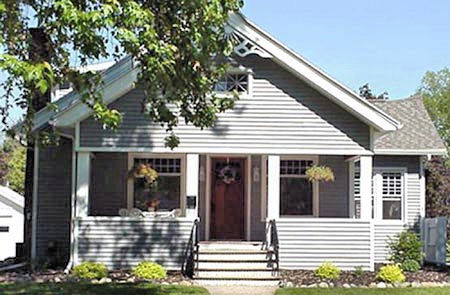
Can you tell us where this is located? Drop us a line at mail@sjindy.com.
709 N. Swegles St.
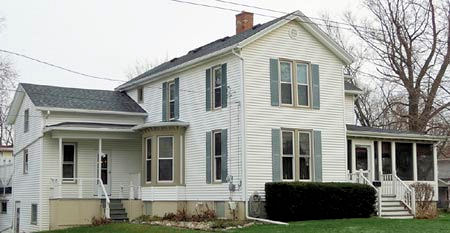
Jonathan D. Pulling writes: This week’s Mystery House is on the Northwest corner of Walker and Oakland streets. I believe that the house number is 209 East Walker Street. I used to go by it on my State Journal newspaper route during the late 50’s/early 60’s. The McMillan family lived there then.
The current owners are Rollin and Jeanette Huard. The Kaisers owned it in the 1950s, and they had an apartment on the west side.
A Look Back – Perrin Palmer PTA Event
by Barry Bauer
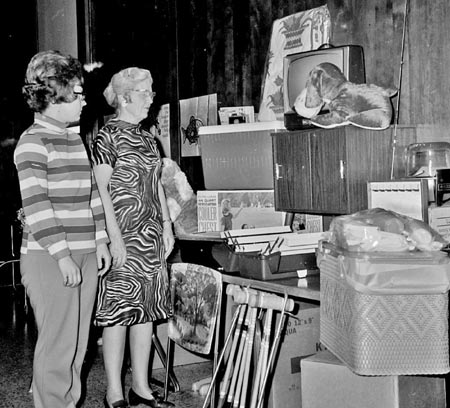
In the early 1970s Mrs. Gary Biddinger and Mrs. Geraldine Whyman look over the items for a Perrin Palmer PTA raffle.
I had Mrs. Whyman as a sixth grade teacher, and she was also the principal. Mrs. Whyman had red hair, and I’m guessing that her favorite color was green because she wore that color a lot. She and her husband owned a late model Buick; and you guessed it, it was green.
Benny and Jessie’s Pet Info –
We all have that friend, relative, or rival who walks their dog with expert leash-wielding skills. They aren’t being pulled down the block, tied ’round trees, or tangled up with the friendly neighbor dog who’s also out for an afternoon stroll. I don’t know about you, but I silently envy the person and pet that can walk side-by-side without breaking a sweat.
Good leash walking skills are important for more than just showing off your pet-parent talents.
“From a relationship perspective,” explains Sarah Fraser, a certified professional dog trainer and co-founder of Instinct Behavior and Training in New York City, “if your dog is walking nicely on a leash, it likely means that your dog is paying more attention to you, making it easier for you to provide direction and guidance as needed along your walk.”
A leash-puller can also run the risk of accidentally breaking away from your grip, which can pose multiple dangers to your pet if he or she continues to run, not to mention the danger for yourself if you end up face-first on the sidewalk. Having proper leash manners minimizes the risk that you will be pulled over in a moment of overzealous leash yanking and will make the time more about walking and less about tug-of-war.
“Teaching your dog to walk nicely on a leash allows you to take her more places and for longer walks, because it’s more comfortable and enjoyable for the both of you,” Fraser says.
Tips for Better Walking Behavior
Whether your dog is big or small, here are six ways to improve your dog’s behavior on a leash:
– Adjust your attitude.
First, ask yourself: “What would I like him or her to do instead?” Instead of teaching a dog to stop pulling, think of it as teaching your dog how to walk nicely beside you.
– Remember it’s all about the rewards.
One of the easiest and most effective ways to start teaching a dog to walk properly on a leash is to reward the dog for paying attention to you and for being in the desired position (next to you or close to you) when out for a walk.
“As the dog learns that walking next to you is a pleasant, rewarding experience, she’ll spend less time pulling and more time walking nicely beside you,” says Fraser. Try using very special treats in the beginning, like small pieces of boiled chicken or roast beef, to really get your dog’s attention, she advises.
– Play the “follow me” game.
Hold on to your leash and take several backward steps away from your dog. The backward movement is inviting, so your dog is likely to turn and follow you. Say “yes!” as your dog approaches you, then immediately reward him or her with a treat.
“The game helps your dog focus and move with you,” says Fraser. Then back away several steps in another direction. Once again, says “yes!” as your dog approaches and reward him or her with a treat. Repeat this pattern eight to 12 times, until your dog is actively pursuing you when you move away.
– Practice on your regular walks.
Once you’ve started your stride, each time your dog looks up at you or walks next to you, says “yes!” and immediately reward him or her with a treat.
– Reward often.
“Frequent rewards will help your dog figure out more quickly what behavior you’re looking for and make the learning process easier for her,” Fraser explains.
“The trick to making this work is using very special treats at first, and keeping your rate of reinforcement high, which just means that you are marking and rewarding often — maybe every 4-5 steps at first — for any and all ‘good’ leash behavior.”
Over time, you can thin out your rate of reinforcement, rewarding your dog less frequently throughout the course of the walk, Fraser adds.
Consider additional assistance.
“If your dog is already a practiced puller, consider purchasing a quality front clip harness to provide extra control on walks,” Fraser recommends. But if your dog already pulls hard on a front clip harness, consider working with a certified, positive reinforcement-based trainer.
Finally, remember that walking on a leash is a skill that takes time and practice for both the pet parent and dog, so celebrate incremental improvements and successes.
Maralyn’s Did You Know? – Kroger Recalls Bakery Fresh Chocolate Brownies
The Kroger Co. (NYSE: KR) said today it has recalled Bakery Fresh Goodness chocolate brownies (16 oz, tub) sold in its retail stores because the product may contain walnuts not listed on the label.
People who are allergic to walnuts could have a severe reaction if they consume this product. For consumers who are not allergic to walnuts, there is no safety issue with the product. One Kroger customer has reported a possible allergic reaction in connection with this product.
All stores operating under the JayC and Smith’s names, as well as Kroger stores located in Georgia; South Carolina; Auburn, Alabama; Greater Cincinnati (including Northern Kentucky and Dayton, Ohio plus South Eastern Indiana); Central and Northwest Ohio; Northwestern West Virginia panhandle; Michigan; Hopkinsville and Bowling Green, Kentucky; Nashville and Knoxville, Tennessee; Huntsville, Alabama; Indiana (except SE Indiana and Evansville); Illinois; Eastern Missouri; Texas and Louisiana; no other Kroger locations are included.
Kroger has removed this item from store shelves and initiated its customer recall notification system that alerts customers who may have purchased recalled Class 1 products through register receipt tape messages and phone calls.
Bakery Fresh Goodness Brownies 11110-09172 Lot numbers beginning with 15307
Purchased between Nov. 7, 2015 – Nov. 16, 2015; 16 oz
Customers allergic to walnuts who have purchased the above product should not consume it and should return them to a store for a full refund or replacement.
Customers who have questions may contact Kroger at 1-800-KROGERS.
Maralyn’s Pet Corner – Feline Hyperthyroidism
Excess thyroid hormone has a number of effects on your cat’s body. Symptoms commonly seen in cats with hyperthyroidism include:
– An increased appetite (sometimes described as a voracious appetite)
– Weight loss (often despite an increase in appetite)
– Increased thirst
– Increase urination
– Vomiting
– Diarrhea
– Restlessness/hyperactivity
Besides these symptoms, several other complications can occur in cats suffering from hyperthyroidism. Heart disease can occur as a result of the toxic effect of the circulating thyroid hormones on the heart. High blood pressure (hypertension) is another potential complication.
Kidney disease is also commonly diagnosed concurrent with hyperthyroidism in cats. Cats suffering from both diseases may need treatment for both and the diagnosis of kidney disease in a cat with hyperthyroidism can affect the cat’s prognosis.
There are several options for treatment of cats with hyperthyroidism.
Radio-iodine treatment, or I131 treatment, uses radioactive iodine to kill the diseased tissue in the thyroid gland. Most cats undergoing I131 treatment are cured of the disease. However, these cats must be monitored for hypothyroidism after treatment.
Surgical removal of the diseased thyroid gland is another potential treatment. Like I131 treatment, surgical treatment is curative but these cats also must be monitored afterward for hypothyroidism.
Medical treatment with methimazole is probably the most common treatment choice. This medication can be administered by mouth or can be formulated into a transdermal gel which can be applied to your cat’s ear. Methimazole is effective in controlling the symptoms of hyperthyroidism. However, it does not cure the disease and, if this treatment option is elected, your cat will need to receive the medication for the rest of his life.
Feeding a diet restricted in iodine is a newer alternative for treatment of feline hyperthyroidism. Like methimazole treatment, this alternative is not curative and your cat will require lifelong treatment.
According to Dr. Ellen Behrend, who presented some new facts and knowledge about feline hyperthyroidism at the 2013 American Animal Hospital Association conference, cats undergoing curative alternatives for hyperthyroidism (I131 or surgical treatments) tend to have longer survival times than those cats undergoing medical or dietary therapy alone. This finding is particularly important for cats that are diagnosed with hyperthyroidism at a younger age.
Another finding that Dr. Behrend reported is that compensatory hypothyroidism is more common in treated cats than previously believed and treated cats need to be monitored accordingly. She also mentioned that correcting compensatory cases of hypothyroidism where applicable can improve kidney function and help resolve some cases of kidney disease, in turn giving these cats a higher quality of life and potentially prolonging their lives.
Another potentially more disturbing finding reported by Dr. Behrend is the possibility that sarcomas, an aggressive form of cancer, may be responsible for more cases of feline hyperthyroidism than previously reported. This finding was reported in one study and needs further validation and exploration. At this point, the significance of the finding is questionable and we’ll have to wait to see whether further research supports the findings in this study. Hyperthyroidism caused by sarcoma of the thyroid gland could be significantly more difficult to treat than that resulting from other causes and this finding raises serious concerns about survival rates for these cats.
Remember When? – The Phone Company
By Maralyn Fink
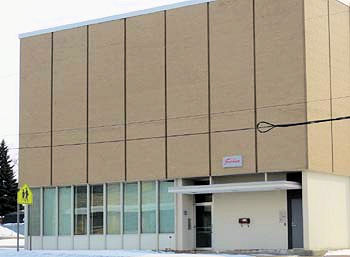
 Back in the day, the phone company was located on E. Walker St not far from the Municipal Building. That is where the operators”were located, and you could pay your bill there also.
There were stairs to climb to the 2nd level, and it was fun to watch the operators pushing and pulling all their cords.
Later the building shown in the picture was built on State St. and became General Telephone. The step up was that they had a drive-up window where you pulled up to paid your bill. I remember doing that in the late 60’s and 70’s.
This was still a time in our life when you could make a phone call to any business and Not get a recording of a mysterious voice telling you to push 1 for this, or two for that, etc. etc. etc.
I guess back in the day in my mind, most things would stay as they were not knowing what I know now. Oh how I long to go back the simpler way of life if just for a day!