Remember When? – Clark & Hulse Clothing Store
by Maralyn Fink
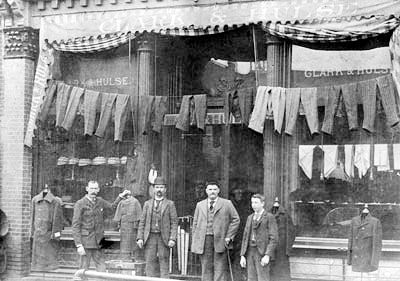
Charles A. Hulse started Hulse Brothers about 1870. The store was located 215 N. Clinton St back in the day.
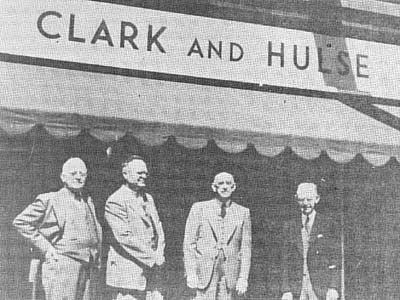
Ray Trempter, Harry Hulse, R.G. Clark and Guy Eaegle
Harry Hulse was associated with Clark & Hulse Men’s Clothing Store for more than 40 years. R.G. Clark became a partner succeeding his father, Robert S. Clark in the business in 1935.
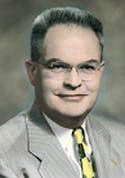 Harry Hulse died on May 10, 1960. Both gentlemen were customer orientated and very nice gentlemen. Customers were their top priority. There was a huge assortment of shirts, ties, dress-wear, casual, shoes and hats that their store provided and I believe that men’s suits were their pride and joy.
Mr. Clark lived at 200 W. Cass St while Mr. Hulse lived at 605 E. Cass St.
Jean reminded me that her mother had taken her to that store to get a man’s shirt and black tie for her Jr. High band uniform. Mr. Jilka did not want girls blouses but men’s stiff colors so that their ties would look right.
Oh, for the good ole days.
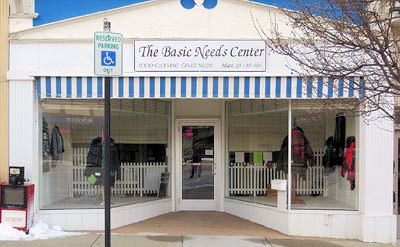
This week’s Mystery Photo
Where is this?
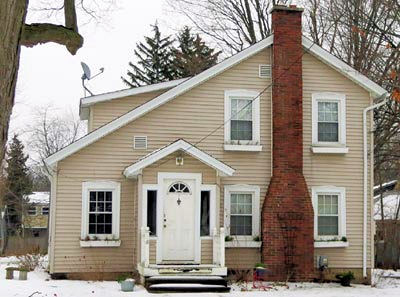
Can you tell us where this is located? Drop us a line at mail@sjindy.com.
******
Jonathan Pulling writes: It is 103 South Oakland Street.
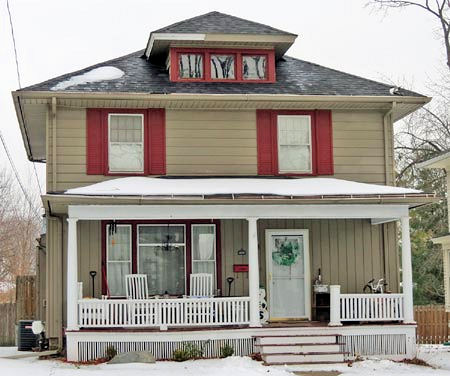
The current owners are Mark and Amanda Medina. Previous owners include Terrance and Dorothy Cornwell, Michael and Carol Manko, Alvin Dickens, David Gaffney, and Stephen and Ned Gibson. In 1950 this was the home of the William Luecht family.
A Look Back – Rehmann’s Men’s & Boys Wear
by Barry Bauer
September, 1966
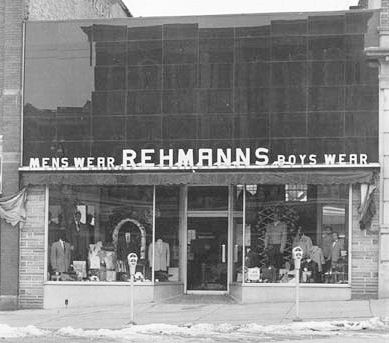
Rehmann’s Men’s & Boy’s Wear at 206 N. Clinton Avenue in St. Johns celebrated its 30th anniversary September, 1966. The business is owned by A. L. Rehmann and sons, John and Norbert. The elder Rehmann learned tailoring in Austria from his father, Jacob, who was a merchant tailor and haberdasher. He came to this country in 1909 at the age of 15. He went to Chicago where he was employed part time as a merchant tailor, and he continued his education there. He later went to Saginaw where he was a partner in a small chain of men’s clothing stores.
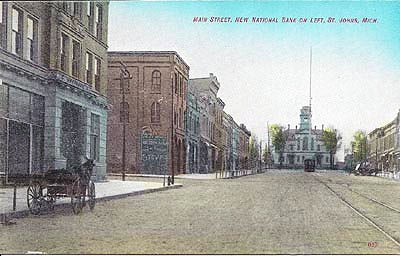
The Rehmanns came to St. Johns in 1936 and opened their first store in the north portion (left of the horse and buggy in the photo) of what was then the Clinton National Bank and Trust Co. building. They offered a complete line of men’s and boy’s popular-priced, nationally known brand name merchandise. Their business in the bank building gradually outgrew the location, and in 1948 the Rehmanns built and moved into the store at 206 N. Clinton Ave. where they were able to handle a large and more-varied selection of merchandise.
A. L. Rehmann is still active in the business and does the tailoring.
John Rehmann has been continuously associated with the business since it was opened in 1936. He is the buyer and manager. Besides his years of experience in retailing clothing, he has had specialized training in practipedics, graduating from the American School of Practipedics, fitting shoes for all types of feet.
Norbert Rehmann served with the Armed Forces from 1942 to 1945 and since graduation from college has been associated with the firm. He is in charge of accounting and advertising and is assistant buyer.
Cy Waldron of Fowler, with many years experience in retailing, is now employed by Rehmann’s as a salesman.
George Weber, assistant manager of the store, has been associated with the business since 1947. He previously served in the armed forces and attended Ferris Institute.
Harry Wiley, of St. Johns, a retired businessman, has charge of Rehmann’s merchandise display and window trimming.
Robert Rehmann, Robert Fox and Robert LaBrie are part time employees. Mrs. Marie Fox is employed in the bookkeeping department.
Regarding the future, John Rehmann commented that, “It has always been our policy in the past, and it will be in the future, to retail first-quality nationally known brands of merchandise. We look forward to serving our many friends and customers in the future.”
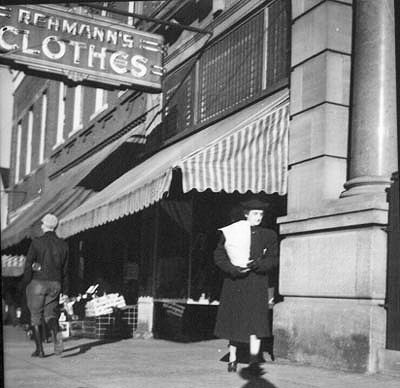
It is mentioned in this article that Rehmanns first location in St. Johns was in the north portion of the old Clinton National Bank & Trust building. At 28 N. Clinton Ave. Harry E. Mack had a shoe store in 1929 and in 1936 he was followed by Rehmanns. That store front has since been filled in and the address gone.
Today Rehmanns is located at 122 N. Clinton Ave. A lot of the people mentioned in the article are gone now.
Benny and Jessie’s Pet Info – Your Pet’s Anal Gland Health: More Important Than You Think
You have friends over for your holiday party and your dog Muffy scoots across the living room carpet leaving an odor that clears the room. Or worse, your cat Morris keeps licking his rear and when you look under his tail there is a hole next to his anus that is bleeding profusely.
Both are experiencing a problem with anal gland health. For Morris the problem is more serious, but in both cases it is important to remember that dogs and cats need an anal gland wellness program. Anal glands need to be relieved, or “expressed,” periodically to avoid scooting or rupture—as in Morris’s case.
So what are these anal glands that caused Muffy to scoot and Morris to rupture and bleed?
Anal Gland Function
Anal glands are the scent glands of dogs and cats, located under the skin near the anal opening (potty port). If you used the clock as a reference the glands are located at 8 and 4 o’clock around the anus. These glands secrete a creamy substance that has a unique odor to other animals of the same species. Think of this odor being your pet’s name to other pets. This is why dogs and cats immediately sniff a new pet’s anal area. They are getting acquainted by learning their new friend’s name.
In the wild, dogs and cats often voluntarily express anal gland fluid to mark their territory. This alerts other dogs or cats that the space is off limits. Anal gland marking is far stronger than urine marking and is not easily “erased,” as is common when dogs and cats urinate where others have done the same. So why do pets scoot and why do the glands rupture?
Surrounding the anal glands are muscles that squeeze to release the anal gland fluid. With domestication and selective breeding many pets have lost the ability to voluntarily squeeze these muscles and empty their glands.
Obesity also plays a role. Approximately 60% of pets are obese. Fat accumulation around the muscles of the anal glands makes it very difficult for pets to “squeeze” the contents of the glands. They must scoot or lick to relieve the build-up of fluid. Fat accumulation around the anus makes scooting ineffective at expressing the contents of the anal glands. Excess fat makes it difficult for pets to reach their anus with their tongues to massage the sac contents out. The fluid accumulates to overflow, becomes inflamed, and ruptures spontaneously, like Morris’s glands. This is quite painful and secondary infection can be severe. Sometimes surgery is required to clean up the mess, but most respond to 2-3 weeks of antibiotic therapy. In all cases glands generally return to normal function.
Anal Gland Wellness
There is a common myth that diet has an impact on anal gland health. You have probably heard, read, or received information from the web that certain foods with certain amounts of fiber can promote a stool size that will regularly empty the anal glands. There is absolutely no scientific data to support this belief. The anatomy around the anus is so diverse and the force of stool exiting the anus so low that the idea of a universal food type and fiber content will solve the problem is misguided.
Some pets never need their anal glands professionally expressed; some need it weekly. Others fall in ranges from needing it weeks to months apart. What is important is finding the regular interval that meets your pet’s needs. For those needing weekly attention, the solution of surgically removing the gland may be a good alternative.
You need to know which interval is right for your pet because anal gland health is as important as other grooming health needs, and even vaccination health.
Don’t wait until you have to catch your pet scooting across the floor and wrecking your party.
Maralyn’s Did You Know? – Good Earth Egg Company Voluntarily Recalls Shell Eggs
Good Earth Egg Company, LLC of Bonne Terre, Missouri has announced a voluntary recall of its shell eggs because they have the potential to be contaminated with Salmonella, an organism which can cause serious and sometimes fatal infections in young children, frail or elderly people, and others with weakened immune systems. Healthy persons infected with Salmonella often experience fever, diarrhea (which may be bloody), nausea, vomiting and abdominal pain.
Maralyn’s Pet Corner – 5 Herbs to Reduce Stress in Your Cat
Some cats are naturally stressed and anxious as part of their demeanor, while others save their freak-outs for car trips and vet visits. Fortunately, effective remedies are available that are both natural and easy to administer. Try these herbs and flower essences to calm your kitty.
Catnip
Why give a substance known to rile up Fluffy in an effort to try and calm her instead? The key to using catnip for relaxing your kitty is to give it to her about 15 minutes prior to the stressful event, such as the dreaded veterinary trip. After she hangs from the ceiling and bolts around the room at lightning speed, she will be worn out and exceptionally calm.
Valerian
This herb is said to mimic catnip, with one significant difference. After her initial crazy-fest, not only will she be very calm, she is also likely to sleep. This herb is also used for humans as a remedy for insomnia and has the same effect on felines. The euphoria induced by Valerian will seriously chill her out and make her more docile than you could ever imagine.
Chamomile
Many people drink chamomile tea before bed to help them relax, and the same anti-anxiety properties are just as effective for cats. However, the dried flowers are a better way to expose Fluffy to its benefits. Studies in animals have shown that chamomile contains substances that act on the same parts of the brain and nervous system as anti-anxiety drugs do. The effect promotes relaxation and reduces stress.
Hops
My cat-parent friends and I have a long-running joke that once the humans have left the house, Fluffy breaks out the kitty beers. Maybe an indirect reason for hops as the main ingredient of lager is its calming effects. But don’t soothe your feline’s nerves by giving her a sip of ale; the dried flowers are more effective and better for her liver.
Bach Rescue Remedy
Humans have known the benefits of this flower essence combination in relieving stress and anxiety and, fortunately, it can also be used with cats (and dogs). Though technically not an herb, its reliable benefits bear a mention in any list of stress-reducing tactics. Perhaps the best feature of Bach Rescue Remedy is its immediate effectiveness. This formulation is great when you need to calm down your cat pronto. Be sure to purchase the alcohol-free version for Fluffy.
How to Administer
Herbs come in many forms – tinctures, dried flowers or leaves, essential oils, and teas are just a few. However, essential oils should never be used on cats due to their liver functioning, which makes it difficult (if not impossible) to break down the compounds and can lead to serious illness – even death.
Due to their delicate systems, the dried form of herbs is safest for kitty use. To prevent her from eating the leaves and flowers, put them inside of a tube collar or make a tiny toy “pillow” with the herbs inside. Kitty will still benefit from the relaxing qualities and be kept safe from over-ingesting them.
If you prefer a tincture, make sure to buy one professionally created by a reputable pet product company with holistic (also known as naturopathic) veterinarians on staff. Even with the best intentions, a home-mixed tincture can be extremely dangerous to your cat. Drops of your purchased tincture can be put in her water for extended calming or squeezed into her mouth for immediate relief.
Teas are best left to humans whose systems are more tolerant of steeped herbs.