Winter Formal fundraiser a success
by Maralyn Fink
Heading back to St. Johns High School on Saturday night, I attended the St Johns Dance Team Winter Formal fund raiser. This is the second year the team, led by Michelle Lindquist, is doing this event.
The décor of small lights followed a path to the entrance of the building, and the small lights carried into the gym.
I was aware of the new rule, set forth by the Administration, that this would be a non grind-dance event. Arriving in the gym, I saw many students dancing and socializing to the music of DJ Rodney Paige.
Everyone seemed to be having a great time, however there were fewer students than normal due to the new rule.
I only wished that more students would have supported the Dance Team in their fundraiser because like any other group they have expenses they need to meet. The money is used to help pay for competition, costumes, music editing fees and other expenses. In an interview, I learned that the team had discussed canceling the dance but decided to go ahead to show that students could have as much fun without the grind-dancing. Many snacks and drinks were on hand for everyone.
In my opinion this dance was a big success, and I think that the Administration has made it clear that this type of dance does not belong in the school system. I also thank Michelle and the Dance Team for keeping the faith and holding the dance as scheduled that night.
The slow dance brought back memories of my high school days back in the day.
Thank you, Michelle and the team and the students present, for letting me take your pictures and for the interview.
I wish you luck in your upcoming competition on Saturday February 6th at 10 am at the High School.
Now that I have spotted the cookies, I really need one for the road!
https://picasaweb.google.com/110845930262453987007/160123?authuser=0&feat=directlink
This week’s Mystery Photo
Where is this?

Can you tell us where this is located? Drop us a line at mail@sjindy.com.
201 E. Lincoln St.

The current owners: Davis and Linda George, Terri. Previous owners include Evelyn Castner, David Skeels, Jeffrey L. and Lynsey R. Smith.
A Look Back – J. D. Robinson
by Barry Bauer
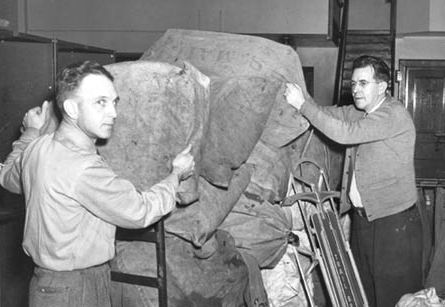
Bob Pratt and J. D. Robinson
When a man becomes president of the Rotary Club, serves as postmaster, and has a variety of hobbies and other organizations to serve, he is what one might call a “busy man.” J. D. Robinson has been a member of the Rotary Club since 1952 and served as vice-president last year and is president this year. The club was organized originally in 1926 and the members meet every Tuesday noon at Walker’s Cafe. They have a present membership of 49.
Theme of the international organization is “Club, Community, Vocational and International Service.” Twice a year the men honor their wives at special dinners and the local group has been especially helpful to the youth of Clinton County. They also aid crippled children, send students abroad to further their college education, and annually sponsor a “Youth Talent Show” where students enter projects in science, arts, and crafts. This year they will help sponsor the 4th of July celebration at the city park and they recently served on the city street clean-up.
To join the club one must be sponsored by a club member, and if his classification can be cleared, the last requirement is approval of the club members. The club requires 90 per cent attendance at all meetings.
Other officers of the club this year are: Bruce Fowler, vice president; Dwane Wirick, secretary; and Ken Munger, treasurer. The board of directors includes: Fowler, Jim McKenzie, and Paul Nobis for one-year terms and Roy Briggs, Don White, Stanley Cowan and John Rumbaugh for two-year terms.
Robinson has been employed at the post office for 28 years, beginning as sub-clerk and carrier. He has served as postmaster for the past ten years. He lives at R-3, St. Johns, and his family includes his wife Erma, one daughter, Jean Martin of St. Johns, two step-daughters, Sharon Huggett of Marlette, and Barbara Waggoner, a senior at the University of Michigan, and six grandchildren. Camping is their favorite hobby and they belong to the “Starcraft Campers Club.” Photography and stamp collecting are other interests, but Robinson has little time to pursue either in depth.
J. D. has lived in Clinton County since he was 4 years old, is a veteran of the Air Force (serving during World War II), a member of the American Legion, and serves on the executive board of the United Methodist Church in St. Johns. He’s also a member of the National League of Postmasters, the National Association of Postmasters and is presently serving as area director of the seventh district.
Robinson says the outstanding memories he has on his career at the office is the big fire they had in July 1962 that caused extensive damage throughout the building. The post office now has 27 employees, three supervisors, six rural carriers, five city carriers and one city auxiliary carrier. They serve 1,927 deliveries on the rural routes and make 2,735 daily stops in the city, for a total service to approximately 15,000 residents per day.
Another interesting item about Robinson is his name. J. D. is all there is to it and people are constantly telling him they want his complete name and not just his initials.
This article is from 1969.
Benny and Jessie’s Pet Info – Canine Flu Update – Vaccines and More
Flu season is upon us, at least in the world of human medicine. Despite the fact that canine influenza doesn’t seem to be nearly as seasonal as human influenza, I thought I’d take the opportunity to update you on some recent changes in the landscape of dog flu.
First of all, veterinarians and owners now have two types of dog flu to deal with. H3N8 strains of the virus were first diagnosed in dogs in 2004, developing after the equine influenza virus mutated and gained the ability to spread from dog to dog. Earlier this year, a new strain—H3N2—arrived in the U.S. from Asia and started wreaking havoc, particularly in the Midwest. Both the H3N8 and H3N2 strains of dog flu are now being diagnosed across large parts of the country.
The symptoms of dog flu are typical of many different respiratory infections. Some combination of coughing, sneezing, a runny nose, poor appetite, lethargy, and a fever are usually seen. It is impossible to tell which virus or bacteria (or combination of viruses or bacteria) is to blame for a dog’s symptoms without laboratory testing. Many veterinary diagnostic labs offer respiratory panels that will identify what pathogens are present. In particular, Cornell University’s Animal Health Diagnostic Center recommends a panel that includes polymerase chain reaction (PCR) tests for “canine adenovirus, canine distemper virus, canine parainfluenza virus, canine respiratory coronavirus, canine pneumovirus, Bordetella bronchiseptica, and Mycoplasma cynos along with matrix influenza PCR. Influenza A positive samples will be further characterized as H3N8 or H3N2 at no additional cost.”
Panels like this one are best run within a day or two of the dog developing signs consistent with a respiratory infection since PCR tests look for the presence of the pathogens themselves. If a dog is to be evaluated later in the course of the disease, antibody tests may be a better option, although previous vaccination can complicate interpreting the results.
Which brings me to the topic of vaccination. An H3N8 dog flu vaccine has been around for a while, but just a couple of weeks ago Merck Animal Health announced that their new H3N2 vaccine received a conditional license from the FDA and is now available to veterinarians.
According the U.S. Department of Agriculture, conditional licenses “are used to meet an emergency condition, limited market, local situation, or other special circumstance.”
The data required for conditional licensure are reduced from that needed for full licensure in that there needs only to be a “reasonable expectation” of efficacy…. Conditionally licensed products must meet the same safety and purity requirements as fully licensed products.
The decision of whether or not to vaccinate a dog against canine influenza can be complicated even when we’re not dealing with a conditionally licensed product. The flu can make dogs quite sick, a few individuals will even die, but most recover uneventfully. Also, flu vaccines don’t actually prevent infection with the virus. They are designed to decrease the severity of the illness that results and reduce the spread of the virus. This last point may be especially important with regards to the H3N2 dog flu virus. As a Merck news release states:
According to clinical studies by researchers at the University of Wisconsin, the CIV [canine influenza virus] H3N2 may be shed for an extended period of time – up to 24 days, which is far longer than what is seen with CIV H3N8.2 As a result, the infection can spread quickly among social dogs in inner cities, doggie daycares, boarding facilities, dog parks, sporting and show events and any location where dogs commingle.
“Based on experimental studies in Asia and the rate of spread we’ve observed, I would estimate that H3N2 produces 10 times more virus than H3N8, which makes it far more contagious,” said Edward Dubovi, Ph.D., Professor of Virology and Director, Virology Laboratory, Animal Health Diagnostic Center, College of Veterinary Medicine, Cornell University. “Preventing the transmission of the disease through vaccination is highly recommended for those dogs that have lifestyles that put them at greater risk.”
Talk to your veterinarian about the pros and cons of vaccinating your dog against H3N8 and/or H3N2 dog flu.
Maralyn’s Did You Know? – House of Flavors Issues Allergy Alert
House of Flavors, Inc. is voluntarily recalling a small batch of 8 oz. cups of Purple Cow Limited Edition Cookie Butter Ice Cream, sold at Meijer stores, that contain Purple Cow Butter Pecan Ice Cream with a Purple Cow Butter Pecan lid. Consumers who may have a severe allergy or sensitivity to nuts run the risk of potentially life-threatening allergic reaction if they consume this product.
For consumers who are not allergic to nuts, there is no safety issue with this product. The company is conducting an internal audit to determine possible cause. To date, there has been one complaint and no illnesses reported related to the recalled product.
Only 8 oz. cups of Purple Cow Limited Edition Cookie Butter that contain Purple Cow Butter Pecan Ice Cream with a Purple Cow Butter Pecan lid sold at Meijer with UPC Code 13733 61945 and marked Best By November 21, 2016 are affected by the recall. The product was sold at Meijer stores in Illinois, Indiana, Kentucky, Michigan, Ohio and Wisconsin. No other Purple Cow products sold at Meijer stores are involved in the recall.
House of Flavors and Meijer are taking precautionary steps, including removing all potentially-impacted products from Meijer shelves and the entire distribution system.
Consumers who have purchased the recalled products should return them to the store where they were purchased for a full refund. Anyone requiring more information should contact House of Flavors consumer affairs at 1-800-930-7740, extension 2229, Monday through Friday 7 a.m. until 5 p.m. (EST).
Maralyn’s Pet Corner – Cat Hairball Problems?
Learn Why They Happen and How to Help
Hairballs are the bane of cat ownership. These clumps of hair bond together in the stomach and then are vomited up in our shoes, carpets and floors. But are cat hairballs normal, and is there any way to prevent them in the first place? Let’s take a look.
Are Cat Hairballs Normal?
Technically speaking, cat hairballs are not normal. Cats have been grooming themselves for thousands of years and their digestive tracts are built to handle the hair that is inevitably swallowed. Hairballs should move through the digestive system and come out the other end. However when this process goes awry, the hair can clump together in the stomach and does not pass into the intestinal tract. It causes enough irritation that a cat will usually vomit up the wad; and voila, you have a hairball.
When I’m presented with a cat that brings up the occasional hairball and absolutely everything else appears to be perfectly normal, vets usually don’t initially recommend an exhaustive work-up (that would take gastrointestinal biopsies). They might perform a physical looking for both GI problems and dermatological conditions that could increase shedding, run a fecal exam, and if they feel they’re warranted (or the owner wants to be especially thorough), recommend a comprehensive panel of blood work (including a check of thyroid levels) and a urinalysis.
Why Do Hairballs Occur?
Cat hairballs can occur for a few reasons, but the vast majority of cases can be attributed to:
1. Ingesting more hair than normal.
Skin diseases (e.g., external parasites, infections, and allergies) can all cause cats to shed and/or groom themselves excessively, which in turn may lead to hairball issues. Extreme grooming can also be associated with stress, boredom, compulsive behaviors, and concurrent illness that is seemingly unrelated to the skin or gastrointestinal system. For example, a cat with osteoarthritis may attempt to soothe herself by stimulating the release of pain-relieving endorphins through repetitive grooming behaviors.
2. Altered gastrointestinal motility.
When a cat’s gastrointestinal tract is not functioning correctly, it may not be able to process even a normal amount of hair in the way that it should. Hairballs can be associated with inflammatory bowel disease, internal parasites, pancreatitis, hernias, foreign bodies, cancers, and other potentially serious diseases.
What are the Best Ways to Prevent Cat Hairballs?
If your cat is having an issue with hairballs, consult a veterinarian. Assuming your cat’s veterinarian finds nothing unusual during an exam, the following is typically recommended:
1. Add fiber to the diet.
The bulk of additional dietary fiber essentially “sweeps” hair through the digestive tract, preventing it from clumping together in the stomach. Discuss with your veterinarian on the best method to add fiber to your cat’s diet. One option is to choose a diet specially formulated with soluble and insoluble fibers to increase digestive activity.
2. Changing diets to a formula with fewer potential allergens.
Gastrointestinal inflammation (often caused by food allergies and/or inflammatory bowel disease) is at the bottom of many chronic cases of hairballs. A prescription, hypoallergenic diet is ideal, but over-the-counter limited antigen foods can be tried as long as owners understand that if a cat’s response isn’t ideal, a more restrictive food trial will still be necessary.
3. Take on some of the grooming ritual yourself
Increasing the number of times per week the cat is brushed will help any of the above solutions work better since any hair that is removed during the brushing sessions are not swallowed by the cat.
As long as your cat is not losing weight or vomiting up hair more than once a week or so, feel free to try some or all of these recommendations before calling your veterinarian. But if they don’t work, it’s time to make an appointment. Your veterinarian can look closely for any health conditions that may be playing a role in the formation of hairballs and make appropriate treatment and dietary recommendations.