This week’s Mystery Photo
Where is this?
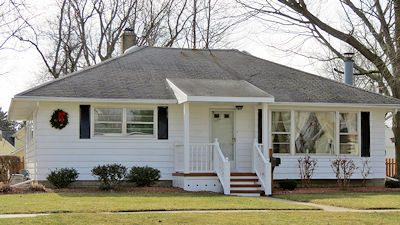
Can you tell us where this is located? Drop us a line at mail@sjindy.com.
207 S. Mead St.

The current owners: Ricky and Jeannie Hudson. Previous owner include: Joseph Karber, Joan Gibbs, Robyn – et al Rehmann. Austin Peck lived there in 1950.
A Look Back – Dr. Paul Stoller
by Barry Bauer

This is a presentation between Dr. Paul Stoller and the two unidentified ladies on the left.
Dr. Stoller had a practice in Fowler before moving to St. Johns. His last office was located at 308 N. Mead St. He passed away at a young age of a heart attack.
Update: Thanks to one sharp-eyed reader we have the full story for you:
Kathleen Cornell (left), of rural St. Johns received a $500 scholarship from the Clinton County chapter of the National Foundation last week, and it was presented to her by Dr. P. F. Stoller, chairman of the scholarship
committee. Looking on is Mrs. Lyle Fenner, outgoing chairman of the chapter”
Full article:
The Clinton County chapter of the National Foundation has awarded its annual $500 health scholarship to a rural St. Johns girl, Kathleen Cornell, 18, daughter of Mr and Mrs James Cornell of West CenterlineRoad, R-5.
Miss Cornell will use the one-year scholarship to start her training for a career in nursing. She will enter the Hurley Hospital School of Nursing in Flint. Her present plans are to specialize in surgical nursing after she becomes a registered nurse.
The scholarship check was presented to Miss Cornell last week by Mrs Lyle Fenner, outgoing chairman of the Clinton
County chapter, and Dr. Paul F. Stoller , chairman of the scholarship committee.
Miss Cornell is a 1968 graduate of Rodney B. Wilson High School in St. Johns, where she was a member of the concert
choir and Wllsonaires, was student director of the play “Oklahoma,” was student council secretary, a member of the National Honor Society and an honor student. She received the Lansing Society of Medicine Technology Award this year. She is also a member of the Pilgrim United Methodist Church.
Members of the scholarship committee include Dr Stoller as chairman, Mrs Luella Canfield, RN, George Eberhard, Dr
G.W. Bennett, Donald Smith, B. Stanley Poculs and CereldaHicks as secretary.
Random Notes – Dorman House is new site of Elsie Arts Council
By Rhonda Dedyne
An item in the Obituaries this week reminded Rhonda of a story she wrote a number of years ago.
Sometimes ants can move mountains.
Or, at least, houses – if the ‘ants’ are committed enough to the cause.
Exactly 100 days from the meeting Sept. 4 where the idea of moving the landmark Dorman House was first discussed by the Elsie Arts Council, what will become the home of the fledgling organization was passing through the main four corners of the village enroute to its new site on the vacant lot where the IGA store once stood.
“It’s pretty incredible,” Arts Council Vice President Maria Menozske said as she watched workers from the Anthes Moving Company inch the house next to the lot where it will be placed onto a foundation this spring.
The dedicated group of area residents managed to raise $16,200 for moving and associated costs in that 100-day period – and overcome other challenges of obtaining the house and securing the use of the IGA lot. Not even the bitter cold temperatures on moving day last Wednesday could erase the smiles on the faces of the EAC volunteers as they watched the house travel west on Main Street and swing around the corner to its final destination next to the Elsie branch of Citizen’s Bank.
“We’re just so pleased that our family home is going to be used and enjoyed by so many people for years to come,” said Phyllis Acre, one of the siblings of Jim Sr. and Esther Dorman who purchased the house in 1942. It was built in 1885.

Dorman, 97, is remembered by many village residents for his love of the arts and inquisitive nature that led him to secure a number of patents. The use of the Dorman House as a new home for the EAC seemed like a natural fit to both the Dorman family and members of the group.
Sam Smith of Smith Funeral Homes had purchased the house and lot for future expansion of his facility that is located adjacent to property. He donated the house to the EAC. Numerous other businesses and individuals also provided cash and in-kind contributions that made the ‘house-moving’ possible – including a $5,000 donation by the Dorman family for use as ‘seed money’ by the EAC.
“We are very appreciative of all the donations we’ve received, and for the assistance of the Elsie Downtown Development Authority and Elsie Village Council,” Menozske said, noting cash contributions made by the Elsie Masonic Lodge and Elsie Improvement Association.
The EAC is continuing to solicit donations which will be used for the construction of a new foundation for the Dorman House, and for renovations to the interior and exterior of the structure once it opens – hopefully, this summer or fall.

“Our goal from the start was to use the house for art classes and workshops, as well as providing a place for local artisans to display and sell their works,” Menozske said. “The four bedrooms upstairs will probably be used for classes and a ‘period’ room to display art from the time that the house was constructed.”
Along with Menozke and Acre, who serves as secretary for the EAC, other officers are Janet Houska, president, and Dawn Levey, treasurer.
A ‘fun’ on-going fundraiser for the organization is the sale of ‘pickets’ for a picket fence that will eventually surround the Dorman House site. Each picket is carved with the name of the donor; the cost is $15 each.
Donations for the purchase of a Dorman House Picket or contributions of any amount may be made to the Elsie Arts Council, 114 E. Oak St., Elsie, Mich., 48831. Donations are tax-deductible via the Capital Region Community Foundation. For information call Menozske, (989) 862-4449.
Benny and Jessie’s Pet Info – How to Alleviate Arthritic Pain During the Winter
Dog Care for Cold Weather Aches
Many people with arthritis will testify that they feel more pain during cold weather. The problem is doctors have not found a reason for why this is. We assume that part of the cause is the drop in air pressure, which can allow the tissues to swell, or the effect that cold has on the muscles; a stiffening that can be uncomfortable even for those who do not suffer from joint issues. The same holds true for animals that suffer from the effects of arthritis. We can see that they are feeling more pain when the temperatures dip, but doctors cannot tell us why this is happening.
What is Arthritis?
First, what is arthritis? The most common type, for both humans and animals, is the type that is related to age, or wear and tear. Called osteoarthritis, damage begins in the cartilage of the joint. Cartilage is a firm but flexible connective tissue that is found between the bones within the joints – including the joints of the knees, hips, and so on.
When the cartilage in the joints begins to erode over an animal’s life, or when it is damaged due to injury to the joint, the bones in the joint are allowed to come into direct contact with each other, eventually resulting in the erosion of and further damage to the bone. The joints most likely to be affected are the weight bearing joints; those in the pelvis, knees, ankles and spine.
What may begin as mild discomfort for the dog over time becomes increasingly painful, and this is especially true for animals that are overweight, as the weight places excess pressure on the bones in the joints.
Although arthritis is a progressive disease without a cure, some of the pain can be alleviated; in some cases, the disease’s progress can even be slowed. Treatment plans often include a healthy, reduced-calorie diet, therapeutic exercise, massage, and anti-inflammatory medications and/or supplements. For some dogs, alternative therapies may also be considered.
Weight Control or Reduction
One of the best things you can do for your dog right now is to make sure you have him or her on a weight maintenance diet, since extra weight places a lot of extra pressure on the already stressed joints. If your dog is already overweight, you will need to start a weight loss diet.
However before you make any drastic food changes — either in type or amount — you should check with your veterinarian. But do it as soon as possible. The longer you allow your dog to remain overweight, the worse the arthritic pain will be for her. Given enough time, your dog will eventually not be able to move around except through a haze of excessive pain.
Needless to say, feeding your dog a quality, low-calorie, low-fat diet will help her to shed pounds and keep them off. There are even plenty of specially formulated dog foods designed for improved joint function in older dogs. Some dog food companies will even send free samples. Do your research, talk to your veterinarian and try samples of different specialty foods until you find the perfect one for your dog.
Additionally, keep in mind that major changes in the type of food may upset your dog, and that some formulas may not be appropriate for your dog’s age and health. Always check with your veterinarian first.
Activity and Exercise
If possible, it is best to take your dog out for regular activity (a little each day or at least four days a week) at a dog friendly park or dedicated dog park. Start out with short walks around the park and work up from there. If you do not have that option, either because of availability or because of weather, there are an increasing number of exercise centers that are being opened for dogs around the country. Most have swimming pools (assuming they’re not already frozen over), a great exercise for arthritic dogs since it is a non-weight bearing activity.
Use your preferred Internet search engine (Yahoo, Google, Dogpile, Bing, etc.) to look for “dog gyms” and “dog activity centers” in your area. Another alternative is to buy your own treadmill to keep at home so that you can exercise your dog at the convenience of your own schedule and in the comfort of your home. Even regular walks up and down the stairs in your building or home are a form of exercise that will benefit your dog (and you).
It is generally agreed that too little exercise is worse than none at all. If you are going to start an exercise plan with your dog, you will have to stick with it, and the more the better. Also, choose exercises that do not stress the joints too much, or you will have a reluctant dog who is too sore to exercise the next day.
Medications and Supplements
There are some medications that may help your dog, depending on the severity of the arthritis. Your veterinarian can prescribe an anti-inflammatory or corticosteroid drug for your dog to reduce inflammation. There are also injectable medications for the promotion of cartilage repair and protection. Dietary supplements generally do not require a prescription. In fact, the most common ones, glucosamine and chondroitin sulfate, are widely used by humans for the management of joint pain.
While supplements are not designed or marketed as painkillers, they do work to repair and reform the cartilage in the joints. For example, glucosamine and chondroitin give the chondrocytes, the cartilage-forming cells, the elements they need to manufacture new cartilage and repair damaged cartilage. These supplements take some time to begin making an obvious effect, however, and need to be given for life to continue to be effective.
Other supplements that have proven useful for arthritis include green-lipped mussel extract, omega-3 fatty acids, MSM (methyl-sulfonyl-methane), ASU, and SAMe. Again, and as always, check with your veterinarian before giving your dog anything new and untried. Even simple supplements might complicate an undiagnosed, underlying health condition.
Alternative Healing
Along with the growth and acceptance of alternative healing techniques for humans, there has been a subsequent rise in the availability of alternative care for dogs, too. Therapies such as massage, acupuncture and physical therapy can be very beneficial for your dog. In some cases, such as with massage or herbal baths, you can provide the care at home. There may be pet massage classes in your area with instructors that teach the specifics of animal massage, or you can do your own research with books written on the topic – either bought from a bookstore or borrowed from a library.
Take note that it is important to know your dog well and know the correct techniques to use before attempting massage. An incorrectly placed “squeeze” could send your dog into spasms of pain and result in a bite on your end.
As before, use your favorite Internet search engine to find local classes or healers that work with dogs.
Stay Warm
Keeping your dog comfortable and warm is important during the cold season. Providing your dog with a well-padded bed in a warm indoor location or placing a heated blanket (make sure it’s pet safe) in his bed can make all the difference in his outlook. Special equipment, such as ramps to go up and down stairs or onto higher furniture, can allow your dog the ability to move freely throughout the house and to go in and out of the house easier.
Clothing can also help to keep the joints warm. Wrap your dog in a specially designed dog sweater, or alter one of your old sweaters or sweatshirts to fit your dog.
Maralyn’s Did You Know? – Allergy alerts
Lipari Foods Issues Allergy Alert on Dark Chocolate Covered Coffee Bean Products
Lipari Foods, LLC has issued a voluntary recall of dark chocolate covered coffee beans packaged by sister company JLM due to an undeclared allergen of tree nuts (almonds). People who have an allergy or severe sensitivity to almonds run the risk of a serious or life-threatening allergic reaction if they consume these products. The products are safe for consumption by those who do not have an allergy or severe sensitivity to almonds.
The products were distributed to retail stores throughout Indiana, Kentucky, Michigan, Ohio, Pennsylvania, Tennessee, Wisconsin and West Virginia.
Products were distributed under the following brand names Angeli Foods, Harding’s Markets, Goosberries Fresh Food Market, Martha’s Vineyard, Hollywood Market, Daniels Foods, Snook’s Butcher Shoppe, Martin’s, Holiday Market, The Purple Onion, Remke Market or as generic product without branding.
Consumers who have purchased this recalled product should not consume it. They should return it to the point of purchase. Consumers with questions should call Customer Service at 800-729-3354, 8:15 am – 4:30 pm, EST, Monday through Friday.
******
Rucker’s Wholesale & Service Co. Issues Allergy Alert on Uncle Bucks and Cabela’s Classic Candies Maple Nut Candy Peg Bags
Rucker’s Wholesale and Service Co. of Bridgeport, IL is voluntarily recalling all of Uncle Bucks and Cabela’s Classic Candies Maple Nut candy peg bag, due to the presence of an undeclared peanut ingredient. People who have an allergy to peanuts run the risk of serious or life threatening allergic reaction if they consume this product.
The recalled Maple Nut candy was distributed nationwide in Bass Pro Shops and Cabela’s stores.
Consumers who would like a refund, or have questions may contact the company at 618-945-2411, or 800-663-1857 Mon – Fri 7:30AM – 4:30PM CST, or email, customerservice@ruckerscandy.com Consumers with an allergy to peanuts should not eat the product.
*****
Peking Food LLC Issues Allergy Alert For Undeclared Egg
Peking Food LLC of Brooklyn, NY, is recalling Chef Hon Brand Steamed Buns With Seafood & Vegetable and Steamed Buns With Seafood Marinated In Xo-Sauce, because they contain undeclared eggs. People who have an allergy to eggs run the risk of serious or life-threatening allergic reaction if they consume these products.
Chef Hon Brand Steamed Buns With Seafood & Vegetable and Steamed Buns With Seafood Marinated In Xo-Sauce, were distributed to retail stores in New York, New Jersey, Connecticut, Massachusetts, Pennsylvania, Maryland, Virginia, West Virginia, North Carolina, South Carolina, Georgia, Florida, Kentucky, Ohio, Illinois, Michigan, Missouri, Alabama, Mississippi, Arkansas, Texas, and Puerto Rico.
Consumers with questions may contact the company at 1-888-686-7888, Monday – Friday, 8:00 am – 4:00 pm, EST.
*****
Wilderness Family Naturals Issues Allergy Alert on Undeclared Milk
Wilderness Family Naturals of Silver Bay, MN, is voluntarily recalling its Wilderness Family Naturals Organic Coconut Milk Powder and other products that contain this ingredient due to potential milk contamination. People who have an allergy or severe sensitivity to milk run the risk of a serious or life-threatening allergic reaction if they consume these products. The products are safe for consumption by those who do not have an allergy or severe sensitivity to milk.
Customers can contact Wilderness Family Naturals for a refund by calling (800) 945-3801 or sending an email to
info@wildernessfamilynaturals.com.
Maralyn’s Pet Corner – Rat Poison Ingestion in Cats
Anticoagulant Toxicity in Cats
Although designed to kill rats and mice, cats often find rodenticides (rat and mouse poison) tempting as well. Most (but not all) rodenticides are composed of anticoagulants, a type of drug that prevents blood from clotting by interfering with vitamin K, a key ingredient in the clotting process. When taken in sufficient quantities by the cat, it results in spontaneous bleeding (internal bleeding, external bleeding, or both). If left untreated, this could prove fatal for your cat.
What to Watch For
Typically, it takes 2 to 5 days for the following symptoms associated with anticoagulant poisoning to appear:
– Bruising
– Pale gums
– Blood in urine, vomit, feces
– Bleeding from gums, nose, rectum, eyes, ears
– Weakness, staggering gait, depression
– Blood accumulation in the chest (hemothorax), which may lead to shallow or labored breathing
– Blood accumulation in the abdomen (hemoabdomen), which may cause the abdomen to distend
Primary Cause
Cats can ingest toxic doses of anticoagulants by eating rodenticide left on the ground or by eating a rodent that has ingested rodenticide. There are many forms of anticoagulant used in rodenticides; some of the more common forms are warfarin, brodifacoum, bromadiolone.
Immediate Care
Call your veterinarian, the nearest animal hospital or the Pet Poison Helpline at at 1-855-213-6680, especially if you notice your cat is bleeding.
If you can find the container or label for the poison, bring it with you to the veterinarian.
Veterinary Care
Diagnosis
If you should witness your cat eating rodenticide or see pieces of rat poison in her vomitus, anticoagulant poisoning is a near certainty. Otherwise, if your cat should start bleeding without cause, your veterinarian will conduct blood tests to determine if the time it takes for the blood to clot is abnormally long.
However blood tests should not be the only determining factor for diagnosis, as the clotting time for a cat that has only recently ingested anticoagulants is normal, only to gradually worsen until the point where the blood can no longer effectively clot.
If there is uncertainty about whether the symptoms are due to an anticoagulant, your veterinarian will do additional tests to make that determination.
Treatment
If the anticoagulant is suspected to have been ingested within the past two hours, and if you have not already done so, your veterinarian will induce vomiting. Activated charcoal is given orally within 12 hours after ingestion of the poison to absorb any of the toxin that may still be in the intestines.
Vitamin K is also given by injection, followed by 1 to 4 weeks of vitamin K tablets given orally at home. The length of the prescription is determined by the type of anticoagulant.
If your cat is actively bleeding, he will be hospitalized and monitored until the bleeding stops. If blood loss is severe, your cat may require intravenous fluids or a blood transfusion. There may be a need for special treatments if other problems should arise. For example, if there is bleeding into the chest, that blood will need to be drained so the cat can breathe easier.
Other Causes
Human medications that contain anticoagulants, like Coumadin® and other blood thinners, are a potential source of anticoagulant poisoning.
Living and Management
Once your cat is stable, she will be sent home with a vitamin K prescription to be given orally. It is best to give it with canned food, as the fat in the food will help it to be absorbed. It is also important for your cat to get the full course of vitamin K prescribed, even if she seems fine. It often takes a while for certain anticoagulants to be eliminated from a cat’s body. Your veterinarian will schedule follow-up tests to monitor your cat’s blood count and clotting time.
Please note: The vitamin K your veterinarian prescribes is in a highly concentrated form. The vitamin K you can buy over the counter is only a small fraction of the strength needed and will not be enough to help your cat.
Prevention
It is best not to use rodenticides if you have pets or young children in your home. There are other products that can control rodents without the use of poison. Your cat may even be willing to help with the rodent control.
In addition, since you have no control over how your neighbors eliminate rodents, it is best not to let your cat outside unsupervised.