This week’s Mystery Photo
Where is this?
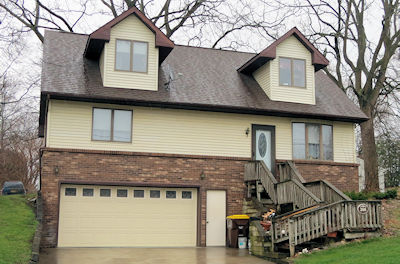
Can you tell us where this is located? Drop us a line at mail@sjindy.com.
404 S. Prospect

The current owner is Christopher Paseka. Previous owners include Robert Ott, and Randall Ott. In 1950 Edna Love lived here.
A Look Back – Saylor-Beall Host Visitors
by Barry Bauer

Recently Stan Zielinski and Robert O’Shanna, national representatives of the Alemite Division of Stewart-Warner Corp. of Chicago, visited the Saylor-Beall Corp. plant in St. Johns. Local plant officials were on hand to welcome them; William Pautke (left) manufacturer’s representative; James Leon, sales manager, R. V. Allman, president; and R. V. Keisel, assistant sales manager.
Zielinski is the national “product manager” for the company and is responsible for product approval of all international and national service representatives and service procedures for the Alemite Corp.
In 1968, when this photo was taken, Saylor-Beall was located at 400 N. Kibbee St. where they’re located today.
A Look Back update

From left to right: William Patton, manager of the Capitol Savings & Loan Association branch in St. Johns and St. Johns’ Michigan Week chairman, Mrs. Brandon White, president of the Friends of the Bement Public Library, Betty Jane Minsky, local newspaper writer and Michigan Week county chairman, and Marion Walling of the St. Johns Woman’s Club.
Patton and Minsky presented the Lester H. Lake Traveling Trophy to two groups in 1968 during Michigan Week activities at the Central National Bank, Friends of the Bement Library represented by Mrs. Brandon White, and the St. Johns Woman’s Club, represented by Mrs. Marion Walling.
The Lake trophy is awarded each year to an organization in recognition for outstanding community betterment during the previous year.
Benny and Jessie’s Pet Info – Carbon Monoxide Poisoning in Dogs
Carbon monoxide is produced by all sorts of everyday equipment: older cars not equipped with catalytic converters, barbecues, or propane heaters and cookers, to name just a few. And in an enclosed space, the levels of gas can quickly become poisonous for dogs.
What To Watch For
A dog near a carbon monoxide leak will first demonstrate lethargy. Unless supplied with fresh air, the dog will eventually fall unconscious and die.
Primary Cause
Carbon monoxide poisoning is generally caused by leaky equipment. This may occur in enclosed, un-ventilated spaces, though even large areas like garages can become a death trap if the leak is not plugged quickly.
Immediate Care
It is vital you move the animal suffering from carbon monoxide poisoning to a wide, well-ventilated area. However, do not put yourself in danger while attempting to rescue the dog. If he has stopped breathing, perform artificial respiration. And if after you check his pulse you notice his heart has stopped, perform CPR (cardiopulmonary resuscitation) as well.
If breathing restarts, contact your vet immediately for advice on how to proceed. If the dog is still not breathing, continue CPR and artificial respiration (if possible) while you transport the animal to the vet or emergency hospital.
Prevention
All equipment that uses propane or produces carbon monoxide as a by-product should be serviced regularly — for your safety as well as your pet’s. Never leave the engine running while a car is in the garage or, if you are performing maintenance on the vehicle, open the garage door and keep the area well-ventilated.
Letters – CASA to celebrate Volunteer Appreciation Week
2016 National Volunteer Appreciation Week is April 10th through the 16th.
CASA-The Voice for Clinton County’s Children joins programs all over the United States to take this special opportunity to say thank you to our program’s super volunteers. We are fortunate to have the support of many which enables us to provide a voice to children who are involved in court proceedings due to abuse or neglect. Special thank you to our CASA Volunteer Advocates who put their heart into their appointed case to ensure their CASA kids are supported throughout their foster care experiences.
Additional appreciation to our Volunteer Board of Directors, Graphic Artist Volunteer, Office Volunteers, Adoption Day Quilt Sewers and Embroiderer, and Event Volunteers. CASA Volunteers are the Superheroes of our program, super thank you to all for your commitment to CASA Advocacy in Clinton County.
Sincerely,
Kelly L. Schafer, M.S.
CASA Executive Director
Maralyn’s Pet Corner – Cat Panting or Breathing Heavily
It is unusual to see a cat pant or breathing heavy, but it does occur when a cat is having respiratory distress (dyspnea). A panting cat does not look that different from a panting dog. Often, the cat will stand or crouch with his elbows bent away from his chest and with head and neck stretched out.
There are many different reasons a cat may have abnormal breathing. This article will focus on fluid in the chest (hydrothorax) and enlarged heart (cardiomyopathy). There is an associated article on asthma and heartworm disease, which affect the lungs directly. Learn more about what to do about feline respiratory problems and cat panting, below.
What to Watch For
– Labored breathing (can include shallow breathing, rapid breathing and noisy breathing)
– Standing or crouching with elbows pulled away from the body, and head and neck stretched out
– Loss of appetite
– Lethargy or reluctance to move
– Hiding
– Coughing (in some cases)
– Bluish or purplish gums
Primary Cause
Fluid in the chest or hydrothorax refers to the accumulation of fluid in the space between the lungs and ribs (pleural cavity). Common causes for hydrothorax include Feline Infectious Peritonitis (FIP), ruptured thoracic duct, and congestive heart failure due to cardiomyopathy.
FIP is a viral disease that the body cannot eliminate, and that causes fluid to accumulate in the chest and abdomen.
Among other things, the lymphatic system collects excess fluid from throughout the body and some of the fat absorbed from the intestines. This fluid is returned to the main circulation by the thoracic thoracic duct connecting to one of the large veins near the heart. If this duct ruptures, then the fluid spills into the chest (called chylothorax), which in turn causes breathing difficulties. The duct may rupture from trauma and other less clear causes.
Cardiomyopathy, or enlarged heart, often leads to congestive heart failure. This is inadequate pumping action by the heart, resulting in fluid accumulation in the chest and/or lungs.
Immediate Care
There is little to be done at home when your cat is breathing heavily and having difficulty. He needs to get to your veterinarian as soon as possible. During transport:
– Minimize stress as much as possible.
– Transport your cat in a carrier or box so his breathing is not compromised by being held.
Diagnosis
If your cat is in distress, your veterinarian will put your cat on oxygen right away and wait for your cat to calm down. The veterinarian will then conduct a thorough physical exam, paying special attention to heart and lung sounds. Chest X-rays are often necessary.
If there is evidence of fluid accumulation in the chest, the fluid will be removed and analyzed, followed by another battery of X-rays. Blood tests will also be done. If the primary problem seems to be the heart, an electrocardiogram and possibly an echocardiogram will be recommended.
Treatment
Treatment is focused on removing fluid from the chest and preventing it from returning so that your cat can breathe easily. Fluid will initially be removed by placing a needle into the chest and manually removing as much fluid as possible. Most cats tolerate this well. Preventing the fluid from accumulating in the chest again is the difficult part, depending on the underlying cause of the breathing difficulties.
FIP – There is no treatment that will eliminate the virus that causes FIP. Once the symptoms of the infection appear, there is little that can be done. The effects of the virus can be suppressed with glucocorticoids (steroids) for a short while, but eventually the cat will succumb to the virus.
Ruptured thoracic duct – This not always treatable. Some success has been had with both medical and surgical treatment options.
Congestive heart failure – Fluid can be held in check with medications like furosemide (a diuretic or “water pill”) and enalapril (improves heart function).
The goal of treatment is also to have your cat feeling well enough to eat and drink on his own. Your cat will most likely be hospitalized for a few days until all these goals are achieved. He may be put on intravenous fluids and receive injectable medication beyond those already discussed to ease his breathing. He may need to be on oxygen for an indefinite amount of time as well.
Other Causes
Other things that can cause difficulty by affecting the chest (pleural cavity): trauma, tumors, hiatal hernia, diaphragmatic hernia, bleeding (hemothorax), and infection (pyothorax and pleurisy).
Living and Management
Most of the diseases that affect the chest will require prolonged or life-long care to keep your cat breathing easy. These diseases generally do shorten your cat’s life span. The worst is FIP, which usually proves fatal in 1 to 2 months. Follow-up visits and tests will be necessary to monitor your cat’s condition. The long-term goal for most of these diseases is quality of life, not cure.
Prevention
There is little to be done to prevent these diseases. Some cases of cardiomyopathy are due to deficiencies of taurine, an amino acid. Commercial cat foods are formulated to supply your cat with a sufficient amount of taurine; you can buy supplements that contain taurine as well. There is a vaccine available for FIP, but the use of this vaccine is highly controversial, and should be discussed with you veterinarian.
Remember When?
by Maralyn Fink

This is the location of Unique Reflections located at 223 N. Clinton today. It is owned by Corrine Trimbach.
Back in the day it was Eiseler’s Superette. The store was a grocery store that carried an old fashioned fresh meat counter among other groceries.
I remember my dad purchasing fresh Kidney for my cat Boots who loved it and him. Those were the days!