Voices for Children
by Kelly L. Schafer, M.S., Executive Director of CASA
 Recently when talking with a community member about the work of CASA-The Voice for Clinton County’s Children encouragement was given to share more about the hard stuff and difficult situations Clinton County children we serve have experienced.
I share some of our CASA (Court Appointed Special Advocates) kiddos’ experiences with caution only because we don’t want to think it, we don’t want to go there.
We don’t want to think about a toddler being the caregiver for a younger sibling; a pre-teen being a caregiver for a parent; little ones who disclose sexual abuse and maybe are not believed; little ones in a home with no available food; kiddos who struggle with big emotions; and little ones who have been home during a drug raid.
Right now it is easier to think about kiddos getting ready for summer vacations, going to the beach, having sleep overs, camping–anything but the unsafe and scary situations described.
Wrapping our brains around situations no child should experience can be difficult–the situations described are a very brief snapshot of what has happened to Clinton County children.
There are bright spots in these difficult situations–9 Clinton County CASA Advocates who support and advocate for children who are in foster care. Their work includes play dough, board games, coloring, helping with homework, playing outside, and navigating life skills. Through the interactions with the children, CASA Advocates present information to the court to ensure children’s voices are heard throughout their experience in the foster care system.
Consider how you can be a bright spot and provide a voice to Clinton County children.
– Become a CASA Advocate (kids are waiting!)
– Participate in our events
– Make a financial gift to our program
– Educate yourself and others
– Stay informed through our Facebook page
– Help to spread the word
– EveryONE can do something
If you would like more information about CASA Advocacy in Clinton County, we would be happy to speak with you. Our work is not easy–but it is always worth it.
For more information, please contact our office 517-599-7145, clintoncountycasa@gmail.com, or visit our website ClintonCountyCASA.org.
This week’s Mystery Photo
Where is this?
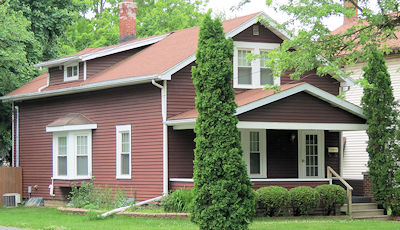
Can you tell us where this is located? Drop us a line at mail@sjindy.com.
306 N. Swegles St.
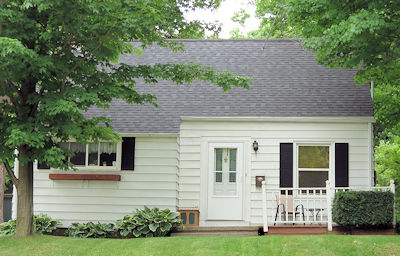
The current owner is Benjamin Bradley. Previous owners include Neal McDiarmid, David Seibert, Gregory Poxson, Roger Howes, Lisa Baxter, Valdemar and Karla Garcia, and Kurt and Wendy Schneider. In 1950 Leonard W Gordon lived here.
A Look Back – New VFW Commander
Barry Clark Bauer

Norman Ketchum has been elected commander of the St. Johns Veterans of Foreign Wars Post 4113 and will take over the duties July 1, 1968. He succeeds Don Devereaux as commander.
Other new officers include Lawrence Peterson as senior vice commander, Ed Schmitt as junior vice commander, John Flak as quartermaster, and Tony Rositas as chaplain.
Benny and Jessie’s Pet Info – Trendy Dog Breeds Suffer for Popularity
A recently published study points to a disturbing trend in dog ownership.
 Researchers analyzed Australian National Kennel Council (ANKC) registration statistics from 1986 to 2013 for 181 breeds. They found that people are becoming increasingly likely to purchase smaller, brachycephalic dogs. In other words, breeds like Pugs and Bulldogs that have a short muzzle, wide head, and prominent eyes.
Why is this a concern? Brachycephalic dogs have more than their fair share of health problems, chief among them brachycephalic airway syndrome. By selecting for this unnatural head shape, we’ve created some potentially serious anatomic abnormalities, including:
– narrowed nasal openings
– a thin trachea (windpipe)
– long soft palate
– outpouchings of tissue into the larynx (voice box)
These characteristics can combine to make breathing very difficult for these poor dogs. Typical symptoms include noisy breathing, working harder than normal to breathe, an inability to exercise normally, a tendency to overheat, and gagging. In severe cases, dogs may collapse due to low blood oxygen levels. Also, small brachycephalic dogs often cannot give birth naturally. Their pups have to be delivered by C-section, the timing of which may not ideal for the pups’ welfare.
Other brachycephalic-predisposed conditions include mast cell tumours, chemoreceptor system neoplasms, hydrocephalus and multiple digestive, ocular and dermatological disorders,” according to the Australian researchers. Most disturbingly, the authors report that “life expectancy is estimated 4 years lower in highly brachycephalic breeds than those not (8.6 years vs 12.7 years).
And this trend toward smaller brachycephalic breeds is not limited to Australia. As the paper states:
The brachycephaly boom seems to be worldwide. In agreement with our results, brachycephalic breeds such as English Bulldogs, French Bulldogs, Boxers, and Pugs have been becoming increasingly popular in the United Kingdom (UK) over recent years, and the numbers of Bulldogs and French bulldogs registered with the American Kennel Club have increased by 69% and 476%, respectively, in the past decade.
Why are we seeing a “brachycephaly boom”? The authors theorize that it has to do with a combination of three factors:
– The increasing popularity of smaller homes, which could limit the appeal of large dogs.
– The round head, prominent eyes, and small nose of brachycephalic dogs are infant-like and stimulate caregiving tendencies in adults, even across species.
– Pure fad
Are you thinking of getting a small, brachycephalic dog? I’m not (necessarily) trying to change your mind, just be aware of the consequences of your decision.
Letters – CASA says thanks

Pictured (left to right) Peggy P., Tri-County Electric People Fund; Liz N., CASA Volunteer Advocate and Board Member; and Kelly S., CASA Executive Director.
Thank you to Tri-County Electric People Fund for the continued generous support of CASA Advocacy since the founding of our program! We had the pleasure of meeting with Peggy P. and Tanya S. with Tri-County Electric People Fund to share more about the impact of their support; thank you for your time.
We appreciate the employees and customers of Tri-County Electric who make this support possible. Thank you.
Kelly L. Schafer, M.S., Executive Director
Maralyn’s Pet Corner – Is There a Way to Stop Cats From Clawing Furniture?
Clawing/scratching is one of those undesirable behaviors that can get a cat in trouble, especially when the item the cat decides to shred is the owner’s expensive couch or carpeting. Often, this behavior results in a frustrated owner and the cat ends up being tossed outdoors or even surrendered to the local shelter. However, that doesn’t need to be the case.
Cat owners do need to realize that, even though the behavior may be irritating to us, it’s a perfectly normal behavior from the cat’s perspective. Cats claw for many different reasons. They mark their territory that way, using both visual and chemical messages. They also scratch to sharpen their claws, helping to keep those claws in tip-top condition. Clawing is used a means of stretching muscles to keep them healthy and supple as well.
Scratching is a basic need for all cats. Your cat is not clawing your furniture out of spite or vindictiveness. He (or she, as the case may be) is clawing because he’s a cat. Fortunately, there are some things that you can do to discourage your cat from using your furniture as a scratching post. Here are some tips.
Provide an appropriate scratching surface for your cat. Scratching posts are fine. Cat trees work well also. Some people even wrap table legs in sisal or other fabric for their cat’s use.
There should be both vertical and horizontal scratching surfaces. Some cats prefer one over the other; other cats will use both.
The scratching post or cat tree should be sturdy enough that it won’t tip over while your cat is using it. In some cases, it may be necessary to secure the post to a solid surface, like the wall.
Encourage your cat to use the scratching area by making it as attractive as possible. Tempt your cat by using a favorite toy on or near the scratching surface. If your cat responds to catnip, rub some on the surface. Or place some favorite food or cat treats on or near the scratching area. Do not try to “teach” your cat to use the surface by placing his feet on it though.
If your cat has already chosen a scratching location that is unacceptable to you, make that area as unattractive as you can. Placing a plastic runner over the surface usually deters a cat from scratching a given surface. At the same time, place an acceptable scratching surface (e.g., a scratching post or cat tree) near the location and make this surface as attractive as you are able.
Once your cat is regularly using the alternative scratching surface, you can slowly move it (a short distance at a time) to a more acceptable location, if desired. You can also remove the runner or whatever deterrent was used to make the original area unattractive to your cat.
Households with more than one cat will require a separate scratching area for each cat. Scratching surfaces are an essential basic need for the feline and your cat may not want to share.
There may be additional help in the future in the form of a pheromone product that simulates the pheromone released from glands in your cat’s feet (called the plantar pad glands) during the clawing process. These pheromones are used as a chemical marker and serve as a means for your cat to tell the world that your home is his territory. A recent study funded by a grant from the Winn Feline Foundation looked at a synthetic version of this pheromone (named the feline interdigital semiochemical, or FIS) and found that “the presence of FIS can influence and prime the location for this important feline behavior (scratching). It also gives specific, long lasting information to other cats. Using the semiochemical approach can modify the choice of areas selected spontaneously by cats. In the future, it could be used as a preventative measure for a cat arriving at a new home or control or change inappropriate scratching behavior.”