This week’s Mystery Photo
Where is this?

Can you tell us where this is located? Drop us a line at mail@sjindy.com.
404 E. State St. – St. Johns, Michigan

Pat Snyder writes that this is 404 E. State St., St. Johns.
The current owners are Richard and Jennifer Gonzales. Previous owners include Diane White, Terry andNancy Sangl, James andLynn Porter, and Timothy Smith.
A Look Back – Calling All Blood Donors
Barry Clark Bauer

That’s exactly what these volunteer workers did Tuesday night in an effort to bring a good turnout for Wednesday afternoon’s semi-annual visit of the Red Cross Bloodmobile to St. Johns. Mrs. John “Corky” Paradise (left) was in charge of the telethon back in 1968 from the General Telephone Co. offices and was assisted by Mrs. Jerry Stone, Mrs. Dick Devereaux and Mrs. Gerald Henning.
The bloodmobile was to be set up from noon to 6 p.m. Wednesday at the St. Johns Municipal Building located on E. Walker St.
Benny and Jessie’s Pet Info – Is Bread Helpful for a Dog’s Digestion?
Have you heard the “old wives tale” that feeding dogs bread can make their upset stomachs better? Well, this is one instance when the “old wives” know what they’re talking about… at least under certain circumstances.
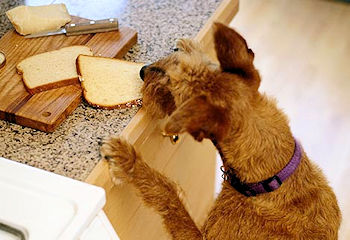
Here are three situations when feeding bread to dogs can be helpful.
1. Your Dog Has Eaten Something with Sharp Points or Edges
Dogs like to chew on bones, but sometimes they go overboard and end up swallowing sharp shards. Dogs have also been known to eat needles, nails, skewers—you name it and a dog has probably tried to eat it. Sharp points and edges can do a lot of damage as they travel through the gastrointestinal (GI) tract. In the most severe cases, they can perforate the esophagus, stomach, or intestines, allowing the contents of the GI tract to spill into the surrounding body part. If the abdominal cavity becomes contaminated in this way, a potentially fatal condition called peritonitis will develop.
When dogs eat a large meal of bread after ingesting something sharp, the bread can encase the foreign material, allowing it to pass more safely through the GI tract. Bread can also help protect the esophagus from sharp bits if a dog eventually vomits or is given medicine to make him do so. Some people recommend white bread, others whole grain. I don’t think it matters. Whatever you have on hand will do.
2. Your Dog Has Eaten a Long Piece of String, Yarn, Thread, or Something Similar
Long pieces of string, yarn, thread, etc., go by the name “linear foreign bodies” in vet-speak. Often, one end of a linear foreign body will becoming anchored somewhere along the intestinal tract. When this happens, the peristaltic action of the intestines cause them to move their way up the string. The intestines become pleated like an accordion, which prevents them from working normally. Left untreated, linear foreign bodies can also cut through the intestinal wall, resulting in peritonitis.
A meal of bread after ingesting a linear foreign body can help the material wad up into a clump and pass through the GI tract.
3. Your Dog Has a Mild, Upset Tummy
I know I’ve experienced this. Sometimes I skip a meal, or maybe I eat something that doesn’t agree with me, but whatever the cause, my stomach reacts poorly and feels “acidy.” Eating a piece of bread can help. What’s going on? I suspect the bread acts like a sponge and traps whatever is irritating my stomach, allowing it to move further down the GI tract without causing more trouble. The same scenario appears to occur with dogs. If you think your dog’s stomach is just a bit off, feeding some bread may help.
Of course, bread is not a cure-all. If your dog vomits more than a couple of times, has profuse diarrhea, is in pain, or is very lethargic, skip the bread and head straight to the veterinary clinic.
Maralyn’s Pet Corner – Common Emergencies for Senior Cats
It can be quite frightening to see your cat suffering, especially if you are unsure whether the situation should be considered an emergency. When in doubt, always contact your veterinarian or the nearest animal hospital. But to hopefully better prepare you, here are some of the most common cat emergencies found in emergency veterinary hospitals around the country.
Choking, Coughing, And/Or Difficulty Breathing
Choking can be a serious problem, even if the symptoms resolve within seconds. Lack of proper oxygenation or the build-up of fluid within the lungs can be a dangerous consequence of choking.
Any difficulty breathing should also be considered a serious problem, requiring immediate evaluation by a veterinarian. Often radiographs are necessary to evaluate the lungs and airways.
Coughing is a vague symptom of several possibilities, including viruses, bacteria, fungal pneumonia, allergic bronchitis, or even congenital heart disease. Any compromise in your pet’s respiratory ability should be evaluated by a veterinarian as soon as possible.
Vomiting and Diarrhea
Vomiting and/or diarrhea can be caused by many different things, including a sudden change in diet parasites, dietary indiscretion, infectious diseases, toxins, metabolic diseases, cancer, and more. Some cases of vomiting or diarrhea may be mild and self-limiting. However, persistent or severe vomiting and diarrhea can be problematic. Your cat can rapidly become dehydrated with these symptoms. Depending on the underlying cause, symptoms can drastically worsen in a matter of hours.
Trauma
Trauma may the result of a being hit by a car, being attacked by another animal, falling from an elevated height, or any other type of accident. Trauma may result in blood loss, shock, broken bones, lacerations and other external wounds, internal bleeding, internal injuries, and pain. It may become life-threatening for your cat. If your cat experiences any type of trauma, he should be examined by your veterinarian, even if he seems unharmed initially. Complications from trauma are not uncommon and early intervention will give your cat the best chance of a successful recovery.
Toxin Ingestion
There are many substances that can be toxic to cats. Among the most dangerous are the plants known as true lilies. Antifreeze is another potential toxin that can be deadly. Cleaning chemicals, medications (both prescription and over-the-counter), garden products (fertilizers, plants, bulbs), chocolate, rodenticides, and insecticides are other potential toxins. If in doubt about whether a substance is toxic, contact your veterinarian for advice.
Foreign Body Ingestion
Cats are curious by nature, and even seniors can be playful. Any foreign body that is ingested can become problematic, either causing gastrointestinal problems such as intestinal obstructions or perforations, or getting stuck in the throat or trachea, causing choking and possibly suffocation. Linear foreign bodies are a particularly common problem in cats. These may include string, rope, ribbon, fishing wire, and other similar items.
Allergic Reactions
Cats can develop allergic reactions. Causes of these reactions range from vaccine sensitivity to insect bites. An anaphylactic reaction is the most serious form of allergic reaction. Symptoms of anaphylaxis include vomiting, diarrhea, lethargy, difficulty breathing, and collapse. Cats may also suffer allergic reactions that include facial swelling, hives and itchiness. Care is necessary if you suspect an allergic reaction in your pet.
Pain
Pain can occur in pets for several reasons and can be displayed in a variety of ways. Pacing, agitation, restlessness, panting, rapid heart rate, or even aggression, are all symptoms of possible pain. Arthritis, dental disease, and trauma are some of the most common causes of pain. If you believe your cat is in pain, seek veterinary help.
Seizures
Seizures are episodes of abnormal electrical activity within the brain. They can be triggered by intra-cranial problems (such as epilepsy, brain tumors, or brain swelling) or extra-cranial problems (such as low blood sugar, electrolyte disturbances, etc). Any seizure can be life threatening. Seizures can occur singly or in clusters, and can occur at any time and in any frequency. If your pet has a seizure, seek veterinary care as soon as possible.
Difficulty Urinating
Straining to urinate is a symptom of more than just a urinary tract infection. Many pets will strain to urinate if they have crystals or stones in their bladder. Inflammation, blood clots, cancer, or even stress alone can all cause difficulty urinating. If your cat is straining and is unable to pass any urine, it is a life threatening emergency that needs to be addressed by a veterinarian immediately.