Remember when? – Remembering Parr’s Pharmacy
by Maralyn Fink
Remembering Parr’s Pharmacy is still fresh in my mind. It was located on the northwest corner of Walker St. and Clinton Ave. This became the home of a pharmacy starting at least by 1862.
The Parr family—Lyman, Dart, Ray and Jim were associated with the business from 1910 until they sold it to Atlas Drugs in 1999. In 1963 the store was expanded to include the adjacent State Bank, which became a gift shop at one time.
The store sold Rexall products which was a big name back then. I remember my dad always bought M31 that could be used for just about anything from bites, a gargle, cuts and whatever else. We always had it on hand. Ray’s son, Jim also became a Pharmacist and worked at the store.
They employed students from the High School, one being Roger Fitzpatrick, who later became a Doctor.
Boxed candy around Christmas time was also a big seller to have on hand, just in case.
The Parr’s had a lot of things in stock and there was always a great selection of anything you could think of.
Everyone took their film or 8mm film to send in for development.
One feature of the store that was a student favorite was the soda fountain located in the back of the store. The Vernor’s with peanut butter crackers were the best.
Ray’s wife, Elma, was a great lady. I remember her bringing in homemade cinnamon rolls to Clinton Memorial Hospital for all the staff to share while I was employed there. She was our guardian angel, and we have never forgotten her kindness.
Well, those were the days!
https://picasaweb.google.com/110845930262453987007/15parr?authuser=0&feat=directlink
This week’s Mystery Photo
Where is this?
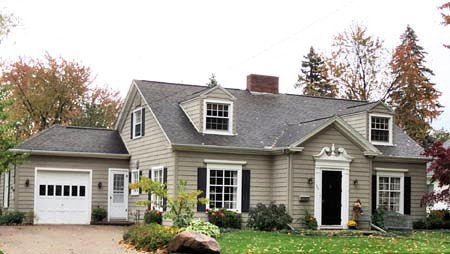
Can you tell us where this is located? Drop us a line at mail@sjindy.com.
******
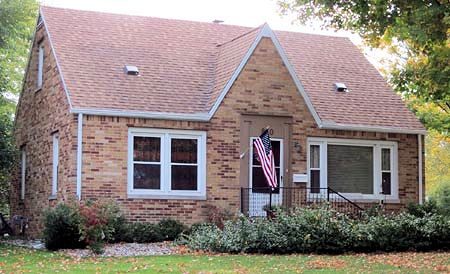
810 Spring St.
The current owners are Richard and Marleen Cornwell. Previous owners include Don and Margaret Boettger, Gary and Diane Boettger, and Clifford Lumbert.
A Look Back – Meals on Wheels
by Barry Bauer
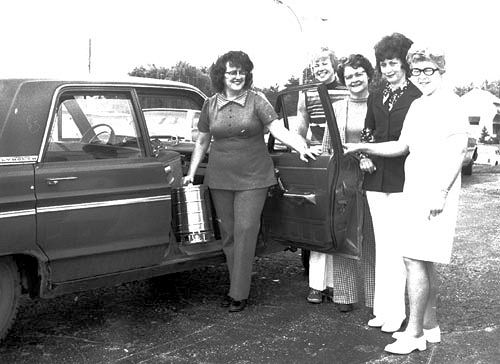
The new Meals on Wheels program in 1973 which provides hot meals for area elderly got underway Monday, with the first deliveries made by Shirley Karber (left). Others working on the project are (from left) Carole Chalmers, coordinator for deliveries; Jean Leon; who collects the money; Joanne Gentry; coordinator for collections; and Maxine Parmalee; hospital Dietician.
Random Notes – Antes sign update

Benny and Jessie’s Pet Info – Are over-the-counter medications safe for my dog?
Much of the time, the answer to this is “no!” Even for those that can be used, many of the time, a more effective dog-specific alternative exists. In fact, inadvertent overdosage of a human medication is one of the top reasons people call the Pet Poison Control Hotline.
Antihistamines, such as Benadryl and Tavist, are some of the more commonly used over-the-counter medication for dogs. Veterinarians may also occasionally recommend over the counter antacids such as Pepcid for certain conditions. Because canine dosages can differ from human dosages, it’s important to get directions specific to your pet if these medications are recommended.
Pain medications is the number one category where owners seem to have problems when it comes to dosing their dog with human medications. Aspirin, Tylenol, and NSAIDS are often given to pets with very variable results. Best case scenario, they just don’t work. Worst case scenario, a pet can go into renal failure or suffer from ulcerations in the GI tract. Worse still, even one Tylenol is enough to kill a cat! I know this is a dog article, but it never hurts to remind people.
Although it may be tempting to skip the office visit and try an Aleve instead, my clients who spent thousands of dollars in the vet hospital after a pet develops bleeding ulcers can confirm: it’s not worth it. Safe and effective veterinary pain medications are always a better choice.
Despite how we think of them, dogs aren’t just small, furry humans. The fact is, there are many differences in the way dogs metabolize drugs compared to people. This can have tragic consequences. Never dose your pet with a drug meant for you without talking to your veterinarian.
Maralyn’s Pet Corner – Seasonal Pet Health Hazards Associated with Fall
Fall is one of my favorite seasons. I fondly recall the sensations associated with brisk autumn temperatures, the aromas of drying plants, and the variety of colors bursting from withering leaves, all of which I experienced while living on the East Coast. Now that Southern California is my home, fall’s climate and vegetation changes are more subtle, yet still highly regarded.
Although many of the seasonal changes associated with fall have great appeal for people, they also present many potential health hazards for our pets, about which owners must be aware.
Dangers Due to Decreased Hours of Daylight
Most peoples’ lives are so busy that we wish there was an extra hour in each day to manage our responsibilities. Therefore, losing an hour of day light when our clocks fall back in observance of Daylight Savings Time’s completion can be frustrating.
Fewer hours of daylight and evening’s earlier start means that we are partaking in many of our daily activities when visibility is poor. Dog owners end up walking or exercising their canine companions in the darkness of early morning or evening.
Reduced light makes it more challenging for drivers to see animals (and people) in driveways, sidewalks, and roads. Having worked in emergency veterinary practice for many years, I’ve observed an increase in the trend of both dogs and cats suffering injuries after being hit by a car during daybreak or twilight hours.
If you walk your pooch or permit your feline companion to venture outdoors, maintain close observation and control by using a leash and collar or chest harness. Have your pets wear up-to-date tags and implant a microchip to improve their likelihood of a safe return should they go missing.
Dangers Due to Leaves
The pleasure associated with observing the colors of fall quickly dissipates upon embarking on the laborious job of cleaning up a seemingly endless supply of leaves.
The startling noises created by leaf blowers may drive your pets into seclusion or cause them to flee your property. Additionally, gas powered devices can leak fuel or oil, which creates a source of toxicity should ingestion occur when your pet licks a substance from the ground or their paws.
Leaf piles remaining on your lawn quickly accumulate moisture, which promotes bacterial and mold growth. If your pet ingests these microorganisms, digestive tract upset (vomit, diarrhea, decreased appetite, etc.) could ensue.
Dried leaves and other plant material may be burned as part of fall’s clean up, thereby releasing smoke and plant based oils (poison ivy, etc.) that can irritate your pet’s eyes, nose, throat, lungs, and skin.
The safest practice is to keep your pets confined indoors, separate from your yard work.
Dangers Due to Plants and Mushrooms
The Chrysanthemum (mum) is a seasonally blooming flower that is commonly associated with fall. Toxicity can occur if your dog or cat ingests the mum’s flower, stems, or leaves, all of which can cause the following clinical signs:
– Ataxia (stumbling)
– Dermatitis (skin inflammation)
– Ptyalism (increased salivation)
– Vomit
– Diarrhea
Other plants producing blooms with a toxic potential for dogs and cats include:
– Meadow Saffron/Autumn Crocus
– Clematis
Mushrooms can also appear in our yard or other nitrogen rich material (mulch, etc.). Fortunately for our companion animals, most wild-growing mushrooms are non-toxic. Differentiating a toxic from a non-toxic mushroom is quite challenging, so it’s best to prevent their consumption by your pet. The Amanita phalloides (death cap) causes severe liver toxicity if ingested.
Dangers Due to Rodenticides
Fall’s cooler temperatures drive rodents in search of shelter from the cold and into our homes. Rodenticides (poisons which kill mice, rats, and other creatures) can help deter vermin infestations, but rodenticide ingestion also causes life threatening toxicity to both dogs and cats. Brodifacoum, the active ingredient in D-Con and a common rodenticide, is an anti-coagulant that inhibits Vitamin K’s normal function in the blood clotting cascade. Within one to seven days post-ingestion, blood fails to properly clot and the following clinical signs occur:
– Lethargy
– Decreased appetite
– Pale mucous membranes (gums)
– Increased respiratory rate and effort
– Bruising
– Bloody feces
– Black, tar-like stools (from digested blood)
Other varieties of mice and rat poisons can contain Cholecalciferol (Vitamin D3), which causes kidney and liver failure, muscle weakness, seizures, and death.
As mice and rats can transport chunks of rodenticide from a container to a location that is accessible to other animals, it’s best to hire a professional service to address your rodent problem instead of putting down easily accessible commercial poisons.
With suspected or known toxicities, immediately contact your veterinarian or emergency veterinary hospital. Additional resources include the ASPCA’s Poison Control Center (888-426-4435) or Pet Poison Helpline (855-213-6680).
Now and Then – Michigan Cranberry Company
by Jean Martin
If they weren’t voted the cutest couple when they graduated from Rodney B. Wilson High school in 1959, they should have been in the running for that and Most Likely to Succeed. Soon after high school Wally Huggett and Sharon Waggoner married and bought a sod farm near Marlette from Wally’s father, Dow. Over the years they raised their four children and continued to expand their farming operation.
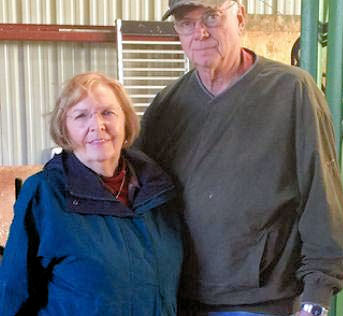
Michigan Cranberry Company started out as an idea, with some potential, in the mind of Wally Huggett back in 1980. In the middle of his sod fields, in the Thumb of Michigan, Wally first started experimenting with growing cranberries commercially. The peat base soil in that location had been farmed for many years and it proved to be too high Ph for viable cranberry growth. Still wanting to try his hand at cranberry farming, Wally searched throughout Michigan for the exact type of land in which to start a commercial cranberry farm.
An abandoned peat mining operation in Cheboygan County came to his attention. This location, being less than five miles from Lake Huron, supplied a good snow cover for winter frost protection on the vines. A high water table to provide a closed irrigation and flooding system, rich peat soil with a low ph and a good mix of sand, made this land ideal for constructing a cranberry marsh.
In 1991 Michigan Cranberry Company was formed. The first beds were planted in 1993 with a respectable harvest in 1998. Currently we are harvesting over three million pounds of cranberries on 150 acres of cranberry beds. In 2010 an additional 70 acres of cranberry beds were planted. Michigan Cranberry Company is the largest cranberry marsh in the State of Michigan, accounting for three-fourths of the state’s crop.
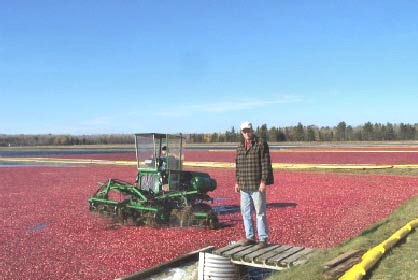
The majority of their cranberries are sold directly to processors and wholesale packers. Through brokers they have exported cranberries to Asia, Australia, East and West Europe and Canada. They have an onsite cleaning and color sorting line that all our cranberries go through. Depending on our requirements, they are then shipped to a packaging plant or direct to the freezer to wait further processing.
Now one of their sons, Mark, owns the farm in Marlette; and Sharon and Wally have retired to northern Michigan to concentrate on their cranberry operation. Today Michigan Cranberry Company produces about three-quarters of the state’s crop. The Huggetts’ operation accounts for 220 of the 300 total acres devoted to the crop, statewide. They raise five different varieties across 45 separate beds-each about five acres-producing 3 million to 6 million pounds of cranberries annually, depending upon conditions.
The spectacle of cranberry harvest has resulted in popular bus tours – often sold out-organized by the Cheboygan Chamber of Commerce for both adults and local school children.
Growing cranberries in northern Michigan is just one more success story in their lives.