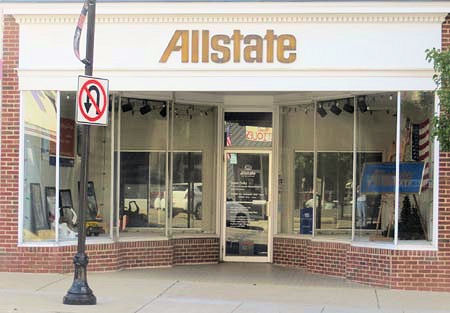
This week’s Mystery Photo
Where is this?

Can you tell us where this is located? Drop us a line at mail@sjindy.com.
607 N Clinton Ave.
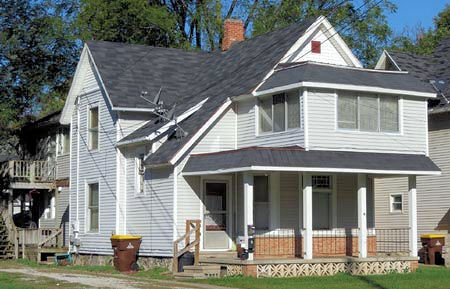
Jane Feldpausch writes: This house is located at 607 N Clinton Ave. The upstairs apartment was my first residence with my new husband in September 1969 until the Spring of 1972. We rented from Sam and Margaret Parks.
Jenny Fleischer adds: This weeks mystery photo is an apartment house with 4 units located on Clinton Ave in the 600 block. We lived in that back downstairs apartment in 1998 for a year while we were building a new house north of St. Johns.
The current owners are Andrew and Marjorie Minarik. Previous owners: include Derwood C. Tuttle, Sam Parks, Clarence Witchell, and Hufnagel.
A Look Back
 A 1972 Football Club Donation
by Barry Bauer

J.W. Staley, left, and Red Devereaux, right, present St. Johns High School Athletic Director Dwane Wirick with a $600 check from the Football Club to help finance the purchase of a universal weight-lifting machine.
The $3,000 unit will be purchased over three years with the help of the club and the athletic department’s activities. The machine will have 15 stations and will be used by the various teams and gym classes for body building and exercise programs.
Random Notes – Sunday’s rare supermoon eclipse
by Rhonda Dedyne
It was a clear night here in St. Johns on Sunday, so I made a feeble attempt to capture the rare supermoon eclipse.
The phenomenon was well beyond the capability of my digital camera’s ability. Any failings certainly could not have been the fault of the photographer.



Benny and Jessie’s Pet Info
 Taking Steps to Prevent Cancer in Pets
Cancer prevention is certainly a “hot-button” topic in human medicine, and many of the same questions and responses surrounding this subject translate to veterinary medicine as well.
The first step in preventing disease is identifying what causes it in the first place. To say a particular variable “causes” cancer would require performing an accurately designed research study—a daunting task in veterinary medicine because of our inability to control for, or accurately record, the variables that could potentially influence a pet’s exposure to risk factors.
An example of a known etiological (causative) factor for a predisposition to cancer in animals occurs in cats infected with either the Feline Leukemia Virus (FeLV) or Feline Immunodeficiency Virus (FIV).
Cats infected with FeLV are 60 times more likely to develop lymphoma/leukemia compared with healthy non-infected cats. Cats infected with FIV are five times more likely to develop the same cancers. Cats co-infected with both FeLV and FIV are 80 times more likely to develop lymphoma than non-infected cats.
FeLV infection was the most common cause of blood borne cancers in cats during the 1960s – 1980s. During that time, approximately two-thirds of cats with lymphoma were co-infected with FeLV.
With the development of better screening tests to eradicate or isolate infected cats, as well as commercially available FeLV vaccines, the number of FeLV positive cats decreased dramatically after the late 1980s. However, cats still frequently develop lymphoma, and the overall prevalence of this cancer actually increased over time. The disease appears to be shifting to other anatomical locations, namely the gastrointestinal tract. What then, is responsible for causing lymphoma in cats now?
There are only a handful of research studies available that examine the causes of cancer in pets. To my knowledge, despite the large body of information on the internet suggesting otherwise, commercial diets, vaccination (other than for sarcoma developments as listed below), tap water, shampoo, or cat litter have not been accurately studied and proven to cause cancer in pets.
There are three “take home” areas I would like to highlight that summarize what we know about proven causes of cancer in animals.
Environmental exposures
The three biggest culprits included pollution, environmental tobacco smoke (ETS), and pesticides. There is evidence supporting an association between exposure to ETS and lymphoma and nasal tumors in dogs and lymphoma in cats.
Exposure to pesticides containing dichlorophenocyacetic acid (2,4-D) is associated with increased risk of lymphoma in dogs; however, data is conflicting.
Dogs living in urban areas are at increased risk for developing lymphoma.
Neuter status
Hormones can act to promote or inhibit tumor development, depending on the specific cancer in question.
Female dogs are less likely to develop mammary tumors when they are spayed early in life, presumably due to lack of exposure of mammary tissue to ovarian derived reproductive hormones.
However, neutering may actually cause an increased risk of developing prostate cancer in male dogs, indicating a possible protective effect of hormones in such cases.
Neutering may also increase risk of developing osteosarcoma and transitional cell carcinoma of the urinary bladder in dogs, regardless of gender.
Administration of injections
The administration of injections (not only vaccinations) can cause injection site sarcomas in cats, but the injection alone is not sufficient to create tumors. More and more evidence points to an inherent susceptibility to tumor development that is “set into motion” in response to the injection.
Despite not knowing the exact causes of cancer in pets, there are several preventative measures owners can take to help ensure their companions remain as healthy as possible for as long as possible.
One of the simplest preventative measures owners can do is to schedule regular physical exams for their pets every 6 to 12 months. This ensures that any changes in status, body weight, etc. are closely monitored and tracked over time so concerns can be addressed as soon as early signs are noted.
Any newly noted skin masses should be evaluated as soon as they are noted. It is impossible to determine if a skin mass is benign or malignant based on appearance or feel alone; a fine needle aspirate and/or biopsy should be performed to determine whether further action is necessary.
Routine lab work and imaging tests such as radiographs (X-rays) and ultrasound scan can also be helpful in assessing a pet’s overall health. Even when we are unsure about how to truly prevent cancer, such diagnostics can mean earlier detection of disease, and can often lead to a more favorable prognosis.
Cancer prevention is an important aspect of any pet’s routine healthcare, and these simple measures can help pet owners and their veterinarians work together to ensure that our beloved companions live longer, happier, and healthier lives.
Maralyn’s Did You Know?
Recall of One Lot of “Good ‘N’ Fun Dog Treats
Salix Animal Health, LLC today announced it has initiated a voluntary recall of one lot of “Good ‘n’ Fun – Beefhide Chicken Sticks” because it may have the potential to be contaminated with Salmonella.
Salmonella can affect animals eating the product and there is risk to humans from handling contaminated products.
Healthy people infected with Salmonella should monitor themselves for some, or all, of the following symptoms: nausea, vomiting, diarrhea or bloody diarrhea, abdominal cramping and fever. Rarely, Salmonella can result in more serious ailments, including arterial infections, endocarditis, arthritis, muscle pain, eye irritation, and urinary tract symptoms. Consumers exhibiting these signs after having contact with this product should contact their healthcare providers.
Pets with Salmonella infections may be lethargic and have diarrhea or bloody diarrhea, fever, and vomiting. Some pets will have only decreased appetite, fever and abdominal pain. Infected, but otherwise healthy pets can be carriers and infect other animals or humans. If your pet has consumed the recalled product and has these symptoms, please contact your veterinarian.
The recalled “Good ‘n’ Fun – Beefhide Chicken Sticks” was distributed nationwide by Salix Animal Health to Dollar General and Dollar Tree retail stores.
The recalled product is packaged in a 2.8 ounce bag stamped on the back side with lot # AO15010 and with an expiration date of 03/2018. The UPC code is 0 91093 82247 1.
No pet or consumer illnesses from this product have been reported to date. However, because of our commitment to safety and quality, Salix Animal Health is conducting a voluntary recall of this product.
The potential for contamination was noted after routine testing by the Georgia Department of Agriculture revealed the presence of Salmonella in one 2.8 ounce package of “Good ‘n’ Fun – Beefhide Chicken Sticks” labeled with the recalled code.
No other product is affected at this time. Customers should look at the lot code and expiration date on the product package to determine if it is subject to the voluntary recall. Customers who have purchased the product subject to this recall are urged to dispose of the product or return it for full refund.
We take our responsibility to pets and their owners seriously and as a result we are investigating the cause of this problem so that we can prevent it from occurring in the future. Salix Animal Health, is also working with retailers to ensure that the affected product is no longer sold and removed from inventory.
If you have these products, please contact Salix Animal Health’s consumer affairs team at 1-800-338-4896, Monday through Friday between the hours of 8:30 AM – 5:00 PM Eastern Standard Time for a refund. Customers with questions may call the consumer affairs team at the number listed above.
Remember when?
Miller Jones Shoe Store
by Maralyn Fink
Who can resist a shoe store especially at a young age?
Miller Jones Shoe Store was in the first block on Clinton Ave. on the West side.

As I said before, I always passed by on the way to work at the Library. Looking thru the window I saw the latest styles of the times.
How would that pair look, I wondered but the price said probably not well.
Maybe they were $3.00, but that was more money than I had.
Through the years, different shoe stores opened in that same spot and by today’s prices for shoes, they were a bargain.