This week’s Mystery Photo
Where is this?
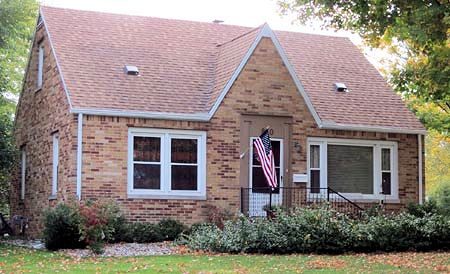
Can you tell us where this is located? Drop us a line at mail@sjindy.com.
******
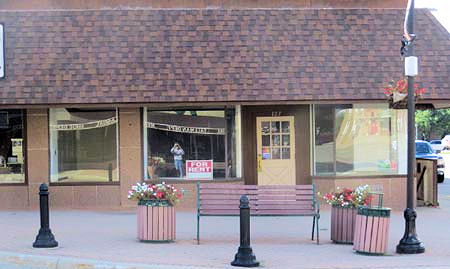
205 W. Walker St.
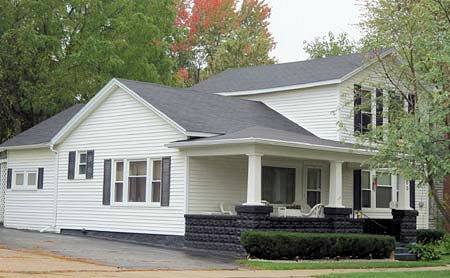
The current owner is Maureen Durbin. Previous owners include Seibert, Schafer, Lanterman, and Cain.
Remembering a hometown hero
by state Rep. Tom Leonard, R-DeWitt
As you drive throughout our state this fall you will notice the beauty of the trees changing colors, the wildlife and the remarkable landmarks this great state has to offer. As you travel for work, for color tours, or for a visit with family and friends, I urge you to also pay attention to the occasional sign on the side of the highway memorializing a portion of the road as a tribute to a fallen hero.
The Michigan Memorial Highway Act provides for these designations, which serve to commemorate our fellow citizens who have significantly contributed to our communities. These Michiganders have served us in the public square, protected us on our streets, or fought for us on foreign soil. Many have paid the ultimate sacrifice in the line of duty.
On December 25, 2006, U.S. Army PFC Andrew H. Nelson, 19, from St. Johns, was killed in battle while serving in Baghdad. An improvised explosive device hit the armored personnel carrier he was driving as part of a route-clearing mission through Baghdad. He had volunteered to drive the lead vehicle in the mission, and his job was to ensure a route for his comrades in arms.
Andrew was born to be a soldier, according to his family. From an early age he wanted to serve others. At age 5, he wanted to be a fireman, and then advanced to the “policeman stage” a few years later. By age 9, he decided he wanted to be a soldier.
PFC Nelson was 14 when terrorists attacked America on Sept. 11, 2001, and he began to seriously consider the Army as a career at that time. When he was 17 he enlisted in the Delayed Entry Program, which allowed him to spend many weekends training and preparing for the military while he attended school during his senior year. He received his diploma in June of 2005, then began basic training a little over a month later.
Nearly 5,000 American military men and women died in the Iraq War. Each death in battle is a very personal loss for family, for friends, for fellow soldiers and for entire communities. Saint Johns mourned the loss of one of its own.
We must never forget those who have given, in the words of Abraham Lincoln, their “last full measure of devotion” to their country. That’s why I introduced a bill to name a portion of Business Route 127 in PFC Andrew H. Nelson’s memory. The legislation, House Bill 4874, calls for signs to designate the memorial highway between West Walker Road and East Townsend Road.
This is, truly, the very least we can do to show our appreciation for Andrew’s service to our country. I am proud to work with his family to make sure that his name and his sacrifice will never be forgotten.
A Look Back – Knights Templar

by Barry Bauer
This 1940s photo shows a gathering of the Knights Templar in downtown St. Johns. Fifth from the right is Don Gilson, the rest are unidentified.
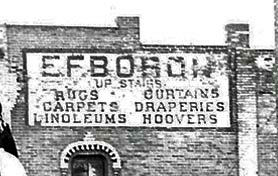
With the recent interest in murals and painted ads on the side of some downtown businesses this one popped up on the former A&P or D&C building seen in the background of this photo.
It reads:
E. F. Boron
Up Stairs
Rugs – Curtains
Carpets – Draperies
Linoleums – Hoovers
Benny and Jessie’s Pet Info
Danger of Homemade Dog Food
I’ve always thought I walk a reasonable line when it comes to homemade dog food. For most owners, myself included, the convenience of having a reputable company design and manufacture a diet that meets all of my dog’s nutritional needs simply can’t be beat. But for those owners who are willing to go the extra mile for their pets, home cooked meals made according to recipes designed by veterinary nutritionists can be a nutritious and delicious option.
I’ve just run across an article that is making me question this line of thought however.
Fifty-nine owners and their dogs who were prescribed homemade diets by the Clinical Nutrition Service, Teaching Veterinary Hospital of the College of Agrarian and Veterinarian Sciences, São Paulo State University were included in the study. The dogs were thoroughly evaluated and then a nutritionally complete and balanced homemade diet was prescribed.
The ingredients used in the recipes included cooked rice, potato, beef, chicken, bovine or chicken liver, carrots, green beans, fish oil supplements, salt, soyabean oil, dicalcium phosphate, calcium carbonate and dried yeast, as well as commercially available vitamin, mineral and amino acid supplements to fulfil minor nutrient requirements. Not all ingredients were used in all diets . . . .
All owners received a written recipe that included the daily amounts of each one of the prescribed ingredients. The veterinary nutritionist carefully explained to owners the importance of following the recipe, the reasons for not changing the type or amount of each ingredient, the nutritional importance of each ingredient used, and details on how to prepare and feed the diet.
What could possibly go wrong?
Well, the scientists surveyed the owners about their experiences with the homemade diets. Some did not end up feeding the prescribed diets, but for the 46 who completed the study:
30.4% admitted they had changed the recipe.
40% did not adequately control the amount of provided ingredients.
73.9% did not use the recommended amounts of soyabean oil and salt.
28.3% did not use the vitamin, mineral, or amino acid supplements.
I find this last point the most shocking. Almost 30% of these owners who received in depth explanations as to the importance of following their recipes did not use their vitamin, mineral, or amino acid supplements AT ALL! Given enough time, these dogs could develop serious nutritional deficiencies.
So before you consider feeding your dog a homemade diet, have a heart-to-heart with yourself and honestly answer these two questions:
– Are you willing to take on the extra effort and expense needed to prepare your dog’s food from a recipe designed specifically to meet his or her particular needs (age, health status, etc.)?
– Will you follow that recipe and not make any changes to it unless you first consult with your dog’s nutritionist?
Maralyn’s Did You Know?
The Truth About Grain-Free Cat Foods
Do you feed a grain-free diet to your cat? Why?
The most common reason I hear goes something like this:
– Cats are carnivores and their natural/ancestral diet contains almost no grain, so cat foods should not contain grain.
There’s nothing wrong with that line of reasoning… but as always, the devil is in the details. Many people who buy grain-cat food actually think they are purchasing a carbohydrate-free product. Just substitute the word “carbohydrate” for “grain” in the statement above:
– Cats are carnivores and their natural/ancestral diet contains almost no carbohydrates, so cat foods should not contain carbohydrates.
I’m right, yes?
But “grain-free” does not mean “carbohydrate-free.” Starch, a type of carbohydrate, is essential to the formation of cat food kibble. Without starch, the kibble will not hold together. Dry foods have to contain a significant amount of carbohydrate. The manufacturers of the grain-free products simply switch out the grains for non-grain carbohydrate sources. Take a look at the ingredient list. I guarantee you will see potato, sweet potato, tapioca, or other non-grain carbohydrates.
Why don’t we change our statement once again:
– Cats are carnivores and their natural/ancestral diet contains almost no potato/sweet potato/tapioca, so cat foods should not contain potato/sweet potato/tapioca.
Still true, right?
If you truly want to avoid carbohydrates (grain and non-grain), you’ll have to feed a canned cat food. Check out the differences in carbohydrate levels between a typical dry and canned formulation. Sorry, it does take some math.
Add up the percentages for crude protein, crude fat, crude fiber, moisture, and ash, and subtract the result from 100%. The result is a ballpark figure for the food’s carbohydrate percentage. If a number for ash is not provided, use 6% as an estimate for dry food and 3% for canned.
Many manufacturers provide these numbers on an “as fed” rather than “dry matter” basis. If this is the case, you’ll need to convert your carbohydrate percentage to dry matter:
Find the percent of moisture and subtract that number from 100. This is the percent dry matter for the food.
Divide your carbohydrate percentage by the percent of dry matter and multiply by 100. The resulting number is the food’s carbohydrate percentage on a dry matter basis.
When I did these calculations for a dry and canned cat food that I had on hand, I came up with a carbohydrate percentage of 35.4% for the dry and 7.5% for the canned.
All canned cat foods are not created equal, either. When you do the math, you’ll find some that have a carbohydrate percentage in the single digits while others are almost as high as a dry food. For example, I looked at two canned cat foods made by the same manufacturer—one was 21.8% carbohydrate on a dry matter basis while the other was 9%.
Under 10% on a dry matter basis is a good, working definition of a low carbohydrate cat food. Unfortunately, you’ll have to do break out the calculator to see if your cat’s food fits the bill.
Maralyn’s Pet Corner
What Cats and Dogs Can See that Humans Can’t: You Won’t Believe it!
Have you ever felt that your cat or dog can see something you don’t? Well, you may be right, according to a new study.
Cats, dogs, and other mammals are thought to see in ultraviolet light, which opens up a whole different world than the one we see, the study explains.
Seeing the World in Ultraviolet (UV) Light
UV light is the wave length beyond the visible light from red to violet that humans can see. Humans have a lens that blocks UV from reaching the retina. It was previously thought that most mammals have lenses similar to humans.
Scientists studied the lenses of dead mammals, including cats, dogs, monkeys, pandas, hedgehogs, and ferrets. By researching how much light passes through the lens to reach the retina, they concluded that some mammals previously thought not to be able to see UV actually can.
“Nobody ever thought these animals could see in ultraviolet, but in fact, they do,” Ron Douglas, the study leader and a biologist at City University London, England, told LiveScience.
What purpose does being able to see UV light serve for animals such as reindeer, rodents, and other mammals? It allows reindeer to see polar bears, for example, which would be invisible in regular light because they blend in with the snow.
UV light also allows mammals to see urine trails. This would be helpful for prey animals, such as cats and dogs, to find food in the wild.
Remember when? – the D&C
by Maralyn Fink
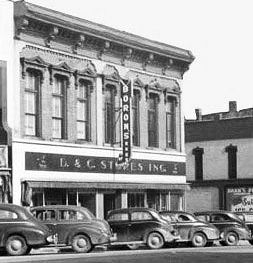
Back in the day, this used to be the D&C store in the first block of St Johns. It took over the space vacated by the A&P when they moved to their new building on West Walker Street. Kenneth Dickens was the store manager for many years, and Wayne Banner took over after Dickens’ retirement in 1968.
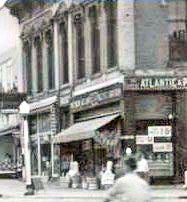
A five and dime was an experience for everyone then and you could just browse and browse and find the neatest stuff. The most important department in the store, the candy counter, greeted youngsters when they first walked in the door. The toy department was located in the far northwest corner of the building.
The D&C was always a must stop if you were downtown for anything. Some children judged the size of nearby towns by the number of dime stores in the downtown area. In this regard St. Johns with two could be compared favorably with Owosso and Lansing. If you ventured to Lansing, there was a big Kresge store there. Owosso had two, one on either side of the street.
In later years it was moved to the middle block of Main St and was managed by Wayne Banner, who was always ready and willing to help his customers. The old candy counter, toys, house wares – they were all still there.
I still have a train set from D&C which was Wayne’s store, that was purchased in the 80’s and you can set it under and around your Christmas tree.
Oh those were the days!

Eddie Boron’s carpet store was located upstairs over the D&C. It was founded in 1923.