Around Town With Barry – Spray Park Splash
an Album by Barry Bauer
https://picasaweb.google.com/110845930262453987007/151104?authuser=0&feat=directlink
This week’s Mystery Photo
Where is this?
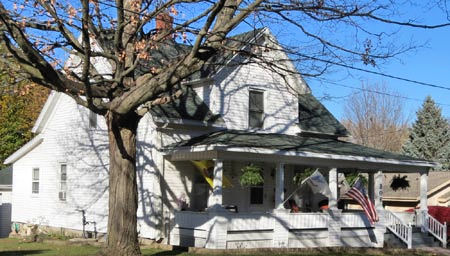
Can you tell us where this is located? Drop us a line at mail@sjindy.com.
709 S. Swegles St.
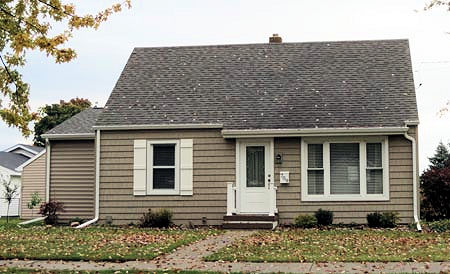
The current owners are Joseph and Dona Pawlowski. Previous owners include: Hicks/McLaughlin/Stanolis, Charles Purvis, Richard Armstrong, Catherine Farrell, Cheryl Parody.
A Look Back – Federal-Mogul Promotions
by Barry Bauer
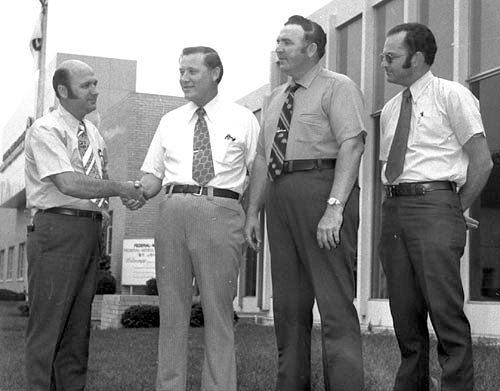
Left to right: Louie Merignac, Art Halfman, Bernard Mankey, and Ed. Davison.
In 1973 Plant Superintendent Louie Merignac has announced the following promotions and additions for the St Johns Federal-Mogul plant:
Arthur Halfmann has been promoted to Unit Manager from General Foreman. Art is a lifelong resident of Clinton County and began his employment with Federal-Mogul in 1948 as a machine operator. During the ensuing years he has held the positions of set-up man, group leader, became Foreman in 1958 and General Foreman in 1966.
Art resides at 501 Wight St, St Johns, with his wife Pat and their 4 children, Shirley 20, Chris 17, Jim 13, and Danny 10.
Bernard Mankey has been has been promoted to Unit Manager from General Foreman. Bernard began his employment with Federal-Mogul in 1948 and is a lifetime resident of Clinton County. He began his employment with Federal-Mogul as a height broach operator and subsequently held the positions of set-up man, group Leader, became a foreman in 1954, and was promoted to General Foreman in 1962.
Bernard resides in St. Johns at 606 West Park St. with his wife, Agatha. The Mankeys have 3 children, David 22, Larry 20, and Dale 17.
Ed Davison has joined the Federal-Mogul plant in St. Johns as a Unit Manager. He comes to this job from his home in Mansfield, Ohio where he was employed by the Empire-Detroit Steel Division of Cyclops Corporation.
Ed is now residing at 205 N. Scott Rd. in St Johns with his wife Marilyn and their 2 sons, Scott 12 and Lee 10.
Benny and Jessie’s Pet Info – Cancer Relapse in Dogs

Cancer Relapse in Dogs is Devastating for Everyone Involved
Lymphoma is a frequently diagnosed cancer in dogs. It is a cancer of lymphocytes, which are a type of white blood cell normally tasked with fighting infections. There are many different forms of lymphoma in dogs, with the most common type (multicentric lymphoma) bearing close resemblance to Non-Hodgkin’s lymphoma in people.
The recommended treatment plan for multicentric lymphoma in dogs is a 6-month course of a multi-drug injectable chemotherapy protocol. This treatment plan is extremely effective at achieving remission, which is a term used to describe when a patient no longer shows any visible, detectable evidence of their disease.
Remission rates are greater than 80%, and survival times can be extended well beyond what would be expected without any treatment.
Remission, unfortunately, does not equate with a cure. Cure would imply that treatment resulted in complete eradication of all of the cancer cells from the dog’s body. Remission indicates the disease is no longer detectable, but is still present.
Ninety-five percent of dogs treated for lymphoma will experience disease relapse (i.e., “come out of remission”). The timing of when this happens is variable.
Relapse typically manifests with the same clinical signs as were shown during the initial diagnosis. For example, if the initial signs of disease were enlarged peripheral lymph nodes that reduced to normal size during treatment, at relapse the lymph nodes would enlarge again.
If the patient was initially administered the multi-drug protocol mentioned above, this is usually considered the most successful plan in re-inducing remission once relapse occurs. The main exception to this recommendation would be a dog who experienced relapse in the midst of, or within a few short weeks of completing, the protocol. In those patients, rescue protocols are more appropriate and effective choices.
There are a many different rescue protocols for canine lymphoma. Among veterinary oncologists, owners are surprised to hear there is no one universally agreed upon “next best” way to proceed. Rescue protocols vary in terms of success of inducing remission, expected duration of remission, number of trips to the oncologist for treatment, chance of side effect, and cost.
Many owners are willing to treat their dog with lymphoma with chemotherapy once. Far fewer will embark on additional treatment once relapse is detected. The variables listed above also influence owner’s decisions about how they would next like to proceed.
For some, cost of treatment is not an issue, and efficacy is their primary goal. For others, the price tag associated with the drugs limits what they are able to pursue.
Even when finances do not play a role, aspects of treatment related to the emotional and time commitments required for appointments influence what an owner is, and is not, capable of.
When dogs with lymphoma experience relapse of disease it is a devastating reminder to owners of their pets’ vulnerability. It means their dog will not be a part of the 5% who are cured. It means revisiting the idea of continued chemotherapy. It means additional obligations they may be unprepared for. And it means genuinely facing their pet’s mortality, which is something they may have deeply buried during the time their dog was in remission.
From a clinician’s perspective, relapse evokes a similar set of emotions. These are owners and animals with which I’ve journeyed through diagnosis and six months of treatment. I’ve learned much about their lives, their families, and, of course, their dogs. When a dog comes out of remission, despite knowing the odds were never stacked in my favor, it still feels like a professional failure.
Once lymphoma resurfaces, it’s a harsh reminder that it was always there, lurking beneath the surface of a pet that otherwise behaves exactly the same as a healthy pet. Though I try to stress that relapse is simply an outward manifestation of the dog’s cancer and that there are many options available to re-induce remission, I remind owners that just because we can do something doesn’t mean we have to do anything.
Relapsed cases remind me that the palliative nature of veterinary oncology is a double-edged sword. I afford pets that have cancer with the chance to live longer and happier lives, which fulfills my goals to be an advocate for animals. But I cannot cure them because I must administer doses of drugs at levels designed to maintain a good quality of life during treatment rather than invoking a cure.
This is a bittersweet compromise I make as a veterinarian, who more than anything, must always ensure that I first do no harm.
Letters – Wilson Center Auditorium Restoration/Renovation Project
When St. Johns area students first attended Rodney B. Wilson High School in 1924, community residents took great pride in the building that featured a beautiful “state of the art” auditorium with outstanding acoustics. Thousands of students performed there in the following decades until the start of the 1969-70 school year when the “new” St. Johns High School opened. At that point, RBW housed middle school students, and the auditorium had limited use to 1998-99 when St. Johns Middle School was constructed. Then, the acoustically perfect venue fell silent.
Fast forward to the early 2000s when St. Johns began planning for its Sesquicentennial Celebration in 2006 that included an original theatrical production about the history of our community. The Wilson Center Auditorium was the most appropriate theatrical space for the Sesquicentennial pageant. Being used for storage, the auditorium was cleared and cleaned. A total of $13,000 was raised from the Sesquicentennial show; that became the seed money for the restoration/renovation of the Wilson Center Auditorium.
Since that time, $70,000 has been raised including a $1,667 grant. All funds are held by St. Johns Schools Foundation for Excellence, a 501 (c) 3 non-profit organization that provides tax incentives for donors. In 2010, the auditorium was completely gutted, repaired and painted. New stage curtains were hung; 212 seats were completely restored; and a sound system added. A lot of the work was in-kind by volunteers; monetary donations came from businesses, community organizations and individuals. Numerous fund-raising performances have been staged at the Wilson Center Auditorium since that time, but the renovation committee was inactive – waiting for an opportunity to complete the original vision of making the space “state of the art” for the 21st century.
Now is that time. The committee reconvened recently, excited and energized to complete the project. At the present time, $20,000 is available for use; the committee needs to raise an additional $60,000 to completely replace the antiquated lighting system, add 140 more restored seats, purchase a projector and screen, and take care of some other minor fixes.
When the project is completed, the Wilson Center Auditorium will be a beautiful, well functioning venue for our community, especially for live entertainment that presently includes an active community theater group, Homegrown Productions, and a community band and choir, and also a children’s choir; and local high school rock bands. We are currently putting a Friday night rock series together that will provide middle school and high school students with a chance to hear some good groups. We are beginning an Open Mic event on a monthly basis for poetry, music, storytelling, etc. A film series and film festival will also be possible when the auditorium has a new projector and screen. The venue will be a great, intimate space for meetings and presentations by speakers on a wide range of topics. The auditorium will comfortably seat 356 people downstairs and an additional 180 in the balcony.
The committee believes there is tremendous potential for community involvement in finishing the renovation of this wonderful hidden treasurer. Whether up on stage or experiencing an event as an audience member, the Wilson Center Auditorium will be another point of pride in our mid-Michigan community, truly adding to the quality of life here in Clinton County and beyond.
Wilson Center Auditorium Renovation Committee
Susan DeRosa
John Gross
Aidan Pope
Darryl Schmitz
Bill Tennant
Beth Webb
Tom Webb
Maralyn’s Pet Corner – Euthanasia is No Longer the Only Choice
Euthanasia is No Longer the Only Choice for Dying Pets
There are two views about a doctor’s role in death in our country, and they couldn’t be more diametrically opposed.
If you are an MD, you live and work in a world where natural death is the norm. Assisted suicide is still an option in its infancy, legal in only four states up to this week, when California became the fifth. The role of the doctor is to preserve life at all cost, even, some might say, at the expense of its quality. Helping a patient end his or her life is, many say, cruel and unnatural.
But as a veterinarian, euthanasia is the norm. It is so far in the opposite direction that I have read some of the most well-respected names in the field state publicly that no pet should ever experience a natural death. The role of the doctor here is to preserve quality of life at all cost, even its length. Prolonging a suffering pet’s life is, many say, cruel and unnatural.
So who’s right?
The answer, of course, is neither and both. Where MDs and DVMs once stood at opposite ends of the rope, both sides are now moving towards the middle. While coroners in Los Angeles were shaking their heads at the role physicians may now play in the death of a patient, I was sitting in a packed lecture hall at the International Association of Animal Hospice and Palliative Care listening to a veterinarian discuss how she supports clients who wish their pets to have a natural death.
Up till now, many clients who do not want euthanasia for any number of reasons were given one of two options: accept it and all the moral discomfort that may accompany it; or go home and let the pet die on his or her own, with little palliative support from the veterinarian.
When veterinarians talk about the cruelty of a natural death, we’re thinking of a situation where there is no support whatsoever. Dying, despite what some people may tell you, can be a messy business. Yes, some living beings may drift off gently into that good night. On the other hand, they may suffer from tremendous nausea, gut-wrenching pain, soiling oneself, the agony of trouble breathing.
Fortunately for us, we have a great model on how to manage all of that: human hospice. A hospice-supported natural death is kind of the opposite of doing nothing; it can be intense. Parenteral fluids. Tube feeding. Round the clock nursing care. Meticulous observation of pain symptoms. It is not an easy path to walk, and many clients who elect to try for a natural death in their pets eventually choose euthanasia. But at least they do so with a clear heart.
And those who do not, have done their duty in providing an ethical death for their pets.
I live for the day when the conversations we have are open and honest enough to determine what is right for each patient and each family, the day when the death of a pet and the death of a person are not so very different. The day we all can make educated choices rationally, and feel, if not good about it, at least at peace.
Because we sure aren’t there yet. But we are on our way.