Vaults bear names of St. Johns pioneers
By Rhonda Dedyne
Names etched in granite on the vaults in Mt. Rest Cemetery comprise a veritable Who’s Who list of the prominent early residents of St. Johns.
Entering from the original old west gate, a walking tour along the gravel road is like tripping through pages of the city’s history. Here rest the physical remains of the men and women who carved a village out of towering forests, laying a foundation for the productive community that thrives to this date.
Following is a brief history lesson on some of these early St. Johns citizens whose deeds and accomplishments spring to life on the shaded grounds of Mt. Rest’s Old Part.
The Old Part of Mt. Rest covers six sections in the most western part of the cemetery, located west of the current main entrance that leads to the Mausoleum. Section A is laid out in a half circle with the lots radiating from the Steel mausoleum – the family vault of R.M. Steel who helped construct the railroad through St. Johns and had a hand in a multitude of other business ventures. His crowning achievement was the landmark Steel Hotel, built in 1888 that was destroyed by fire March 28, 1975.
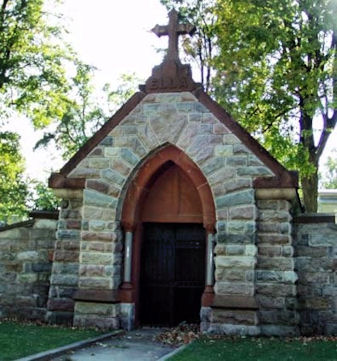
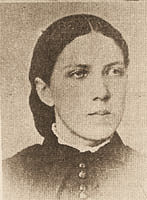 Section A also contains the so-called “Ella” vault. It is amed in memory of Ella Perrin, daughter of another early St. Johns patriarch, H.M. Perrin.
Ella was killed in a railroad accident in 1889 near Rochester, N.Y., when she and her parents were returning from a family reunion in Vermont. The vault was originally built for use as a temporary holding vault for bodies when weather hampered burials.
One of the more interesting stories that unfolds on a walking tour of the Mt. Rest Cemetery Old Part has as its focal point the Babcock family vault, located on Lot 59 near the Ella vault. Charles T. Babcock, son of Marvin Babcock, Esq. and Effie Babcock, built the private mausoleum in the 1902s. His parents’ bodies were interred in the cut-stone building; his own interment took place August 2, 1926.
Marvin Babcock was among the first merchants in St. Johns, owning a jewelry retail business. He and his wife were among the earliest St. Johns families, living in the home located on the northeast corner of Oakland and State Streets.
Charles was a U.S. Government Indian Agent; he prospered as a trader and investor in the Indian Territories. Upon his return to St. Johns, he was equally successful in business ventures in central Michigan. He was President of the Union Telephone Company, which originated in Alma in 1899. The company acquired the National Telephone Company in 1901. The National Telephone Company was the first such business in the City of St. Johns, established in 1889. By 1910, the Union Telephone Company was providing service to Michigan’s 13 central counties. It continued to expand, and was acquired by General Telephone Exchange (GTE) in 1957.
Charles was one of the first individuals in St. Johns, and probably mid-Michigan, to own an automobile. A newspaper article dated April 17, 1902, reads: “Charles T. Babcock received his new Olds automobile and it runs like a top. It carries enough gasoline to run 100 miles, and has a 4 H.P. engine, and slow motion gear for hill climbing. It cost $650.”
His wife, Mary, also held a prominent place in the social history of St. Johns. She was the daughter of another important St. Johns resident, Gen. Oliver Lyman Spaulding. Mary helped organize the St. Johns Literary Club, serving as its first president. In 1895, it federated with the State Federation and became part of the General Federation of Women’s Club. The St. Johns Chapter of the GFWC played a vital role over the years in countless charitable fund-raising and community events.
The Babcocks purchased the Spaulding home on Oakland Street in the early 1900s, enlarging it for a second time about 1911. The “Babcock Mansion” soon became a focal point for St. Johns society, often entertaining guests in the third-floor ballroom. Mary is responsible for the application of pastel frescoes as part of the decorative plaster in the music and library rooms.
Section B in the Old Part of Mt. Rest includes lots set aside by the cemetery association to bury military service persons. It contains the GAR memorial, and a marker for the Unknown Soliders. Seven unknown Civil War soldiers are buried here.
Section C is unique for the vault that is no longer there. The Hicks family, one more in the list of Clinton County pioneers, originally had a cut-stone vault that was disassembled and moved with its contents by rail to New York. It was reassembled there, and the bodies re-interred, although the burials remain in Mt. Rest records.
Located on the north border of the Old Part, Section D contains the Catholic Burial Grounds. A simple masonry cross on lot 99 marks the mass grave of re-interred bodies which were brought from the Old Calvary Catholic Cemetery of St. Joseph Church in 1925.
Two of the four “Baby Land” plots in Mt. Rest are located in Section E, as is a section called “Potter’s Field” which is set aside for the burial of the poor. Plots in Baby Land were often used by individuals who did not have family plots purchased at the time of the death of their infant children.
Section F faces the front of the Old Part, east of the drive and along Steel Street’s wrought-iron fence. The Bunday Family vault stands at one end of the section, housing the remains of 10 family members.
Although it is technically located in the ‘New Part’ of Mt. Rest, the Mausoleum is a focal point of the entire cemetery, situated at the top of the circular main driveway which branches off to each side for entry into the Old Part and New Part sections. Built in 1919, the Mausoleum contains 450 crypts, each having a faceplate of marble. The building features stained glass windows and a marble interior.