This week’s Mystery Photo
Where is this?

Can you tell us where this is located? Drop us a line at mail@sjindy.com.
511 S. Oakland St.

The current owners are Mark and Jamie Travis. Previous owners include Karen (Pohl) Knight, Randall Patton, Michael Drinkert, Wayne Peterson, Jeffrey Jones, and Alan and Leslie McCarrick. This house was the home of the Herman Pohl family for many years.
A Look Back – Jaycees Fund Drive
by Barry Bauer
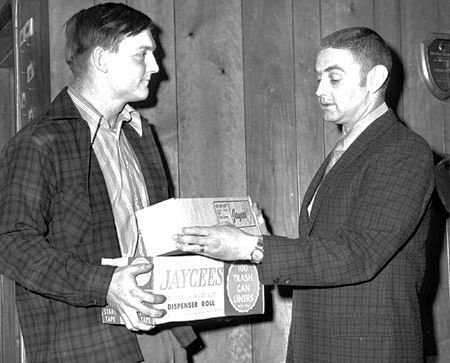
In the 1970s Wayne Woodbury (left) and Wayne Banner prepare for another fundraiser by the local Jaycees. This time they will be selling trash bag liners at sites throughout the city.
Wayne and Diana Woodbury are owners/operators of Woodbury Flower Shop and Wayne Banner was the long time manager of D & C Store before it closed. I know a lot of people who miss this store, my wife included.
Benny and Jessie’s Pet Info – Healthy Snack Ideas for Dogs and Cats
Like buying candy for kids, we often think snacks that have been specially packaged for pets are the best treats in the world. Why would they want anything other than a tasty treat? But, a lot of those packaged pet snacks and treats are the equivalent of candy. They are not a big deal, as long as you don’t do too much of it, since they are mostly devoid of nutritional value.
And just as we encourage kids to eat their veggies rather than another candy, we can also encourage a love for veggies in our pets. These low calorie, low fat, vitamin and mineral-packed “treats” are a great alternative to the packaged dog biscuits and kitty chews.
Which Fruits and Vegetables Are Best, and Which Are Not Safe for Pets?
There are some plant foods that are toxic to pets, so you will want to be familiar with what to avoid and even prevent access to. If you are unsure, check with your veterinarian to make sure that your planned treats are not going to be harmful to your pet. Also keep in mind that while dogs are omnivorous, and therefore more open to trying different kinds of foods. Cats, on the other hand, are carnivorous. They are not just picky about what they eat; they are constitutionally incapable of digesting some types of foods.
Here is a brief list of healthy treats that have been found to go over well with a lot of pets, followed by a list of foods you will need to avoid.
Yes:
Apples – without seeds or core (apple seeds contain chemical compounds that are poisonous to animals)
Blueberries
Strawberries
Watermelon – without seeds
Cantaloupe
Frozen bananas
Green beans
Carrots – raw or cooked
Sweet potato – cooked, cubed or mashed without butter or seasoning; regular potatoes are also good, but in limited amounts since they are high in sugar and can increase weight
Squash, zucchini
Lettuce
Spinach
Popcorn – unsalted and un-buttered
Catnip or cat grass
No:
Grapes and raisins – contain chemical compounds that are toxic to dogs
Garlic and onions – both have chemical properties that can be toxic, and even life threatening to dogs and cats
Tomatoes
Avocado
Mushrooms – particularly wild mushrooms
Fruits with pits, such as peaches, cherries, and plums – in some cases the pit can be toxic, or can simply present a choking hazard
Nuts – particularly macadamia nuts, which are toxic to pets
What is the Best Way To Feed These Types of Treats?
The foods should be baked or steamed, cut up into smallish pieces, and only given in small amounts at a time. This will prevent both choking and an overload of carbohydrate- and calorie-rich foods. You can give the vegetables and fruits by themselves, or you might mash or puree them and mix them up with the prepared food and given at meal times.
Replacing your pet’s dense, high fat packaged treats with healthy treats like fruits and vegetables will be one of the most beneficial things you do for your pet. Over the long term, your pet’s health and immune system will be stronger, aging will not be as severe, its weight will stay steadier, and if weight is already an issue, you may even see your pet’s weight become more manageable — if you stick to it and include moderate exercise.
With any change in diet, it is important to observe your pet for issues that can arise in response to the change. If your pet begins to show digestive or behavioral changes, stop feeding the new foodstuff and consult with a veterinarian if the problem does not go away in the absence of the added food.
Maralyn’s Did You Know? – Stella & Chewy’s Recall
Stella & Chewy’s is voluntarily recalling select lots of Frozen Stella’s Super Beef Dinner Morsels due to potential contamination with Listeria monocytogenes.
According to a company release, Stella & Chewy’s was notified by the Michigan Department of Agriculture and Rural Development that it had issued a stop sale order on Stella’s Super Beef Dinner Morsels for Dogs because it tested positive for Listeria monocytogenes.
As a precautionary measure, the release said, the company is voluntarily recalling selected products from the affected lot.
The following Stella & Chewy’s pet food products are being recalled:
Frozen Stella’s Super Beef Dinner Morsels for Dogs 8.5 oz. 186011 001554 165-15 6/25/2016
Frozen Stella’s Super Beef Dinner Morsels for Dogs 4 lb. 186011 001370 165-15 6/25/2016 & 6/26/2016
Frozen Duck Duck Goose Dinner Morsels for Cats 1.25 lb. 186011 001455 165-15 6/25/2016
The company said they are also recalling the following products which may have come into contact with the affected lot:
Frozen Chick Chick Chicken Dinner Morsels for Cats 1.25 lb. 186011 001448 160-15 7/2/2016
Frozen Chick Chick Chicken Dinner Morsels for Cats 1.25 lb. 186011 001448 152-15 7/2/2016
Listeria monocytogenes is an organism which can cause serious and sometimes fatal infections in young children, frail or elderly people, and others with weakened immune systems. Listeria infection also can cause miscarriages and stillbirths among pregnant women.
If you or your pet had contact with the recalled product, you are advised to watch for symptoms that may develop. Common symptoms associated with Listeria infection include high fever, severe headache, stiffness, nausea, abdominal pain, and diarrhea. If you, your pet or a family member is experiencing these symptoms, you are urged to contact a medical professional.
For more information, the release asked customers to email questions to info@stellaandchewys.com.
Letters
From Superintendent Martin regarding the Facilities Study
 Last night our Board of Education heard an extensive and comprehensive presentation from the Facilities Committee for the very first time. The charge of this committee originated from the Student Enrollment Trend and Facilities Impact presentation made to the Board of Education back in May of 2015. This May presentation chronicled multiple years of declining student enrollment in our state, county and our district.
Based on this information, the committee conducted an in-depth analysis of how our current facilities are utilized and provided recommendations for future needs and direction last night at the board meeting. During this meeting, the Board of Education did not take any action.
In my previous communications I informed everyone that we would make the presentation and all other supporting information that the committee reviewed available. This morning, the full presentation, along with a number of other documents, and a list of Frequently Asked Questions (FAQ) have been made public on the district website at the following link: http://www.sjredwings.org/facility-committee-/
After the holiday break, we will communicate several dates, times and locations where we will conduct community forums to review a shortened version of this presentation. During these forums we will allow ample time for questions and answers, as well as listening to concerns and other creative ideas that you may want to share.
While no final decision has been made, the district’s administrative team will review all information and considerations as we prepare for a final recommendation for the Board’s consideration. We invite you to look over the available information and share your questions, comments, suggestions or compliments with the district and/or Facility Committee as we move forward via Let’s Talk.
I again want to thank the committee of volunteers who spent a significant amount of hours studying current and past information to help our district think wisely about how we can best utilize our resources to support and enhance the high quality learning opportunities that St. Johns has provided for so many years.
Thank you and Happy Holidays!
Sincerely,
Dedrick Martin, Ed.D.
Superintendent – St. Johns Public Schools
Maralyn’s Pet Corner – Gifted Pets Often Become Returned Pets After Holidays
For better or for worse, the holidays often bring new pets into our households. Your addition may have been well-planned and thoughtfully implemented, which is always the recommended course. However, many new pets end up in our homes either as gifts or as our own impulsive purchases or adoptions.
While I never recommend giving a pet as an unexpected (i.e., surprise) gift, it happens. And when it does, it often places a pet into a household where it may not be all that welcome. As a result, that pet often ends up surrendered to a shelter or rescue shortly after the holidays conclude.
Impulsive purchases are a bit different but the result is often the same. When the addition of a pet is unplanned, new pet owners may find themselves in a position where they are financially or physically unable to care for the new pet. Or they may simply have second thoughts about having the pet in the household.
Whatever the reason, the period immediately following the holidays unfortunately finds a lot of puppies, kittens, dogs, cats, and other pets being surrendered to shelters and rescues. For some shelters and rescues, this happens less frequently than for others. Shelters and rescues that screen adopters carefully and prohibit the adoption of a pet as a gift for someone else are probably less likely to see as many returns, I should think (though I admit I have no statistics or studies to back up this thought). However, not all shelters have the luxury of being so discerning.
What happens when a pet is returned to a shelter or surrendered to a rescue after the holidays? That animal, which may have already had time to begin to bond with its new family, is now placed back into a cage. He certainly does not understand what he did to deserve to be abandoned again. He does not understand that his “new people” did not plan adequately for him or never wanted him to begin with. For that animal, the situation becomes stressful, depressing, and frightening.
Can these animals be re-homed a second time? Yes, many of them will adjust to another home, which hopefully will be better prepared for the arrival of the new pet. Some of these animals may still need training, especially in the case of young or adolescent puppies, which may not have received adequate house training guidance and/or socialization in their previous, short-lived home. But they can still make good pets for someone willing to take the time.
Many of these pets will become loving and loyal companions. That is assuming, though, that a new home can be located. Unfortunately, that is often easier said than done, and too many pets end up meeting an unpleasant end when there are no new homes for them.
What is the moral of the story? If you did not adopt a pet this holiday season, hopefully you already know that the holidays are perhaps not the best time of year to adopt a new pet and, likewise, hopefully you will never make the mistake of adopting a pet you are not prepared to care for.
If you did adopt a pet, for yourself or for someone else, and now find yourself in a position where surrendering that pet is inevitable, accept that you made a serious mistake in judgment. Learn from that mistake and vow never to repeat it. After all, it is not really you that suffers for this transgression. It is the pet that pays the ultimate price.