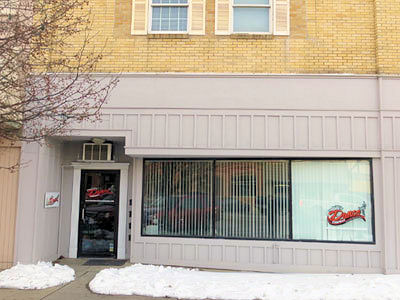
This week’s Mystery Photo
Where is this?

Can you tell us where this is located? Drop us a line at
mail@sjindy.com.
******
307 S. Oakland
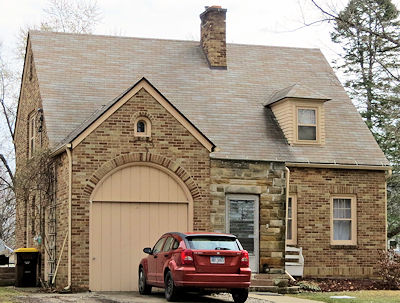
The current owners are Brian & Cathy Keyes. Previous owners include Bazil Southwell, David and Patricia Johnston Sr., and David Jr., Dan, Veronica Johnston.
A Look Back – Come Blow Your Horn
by Barry Bauer
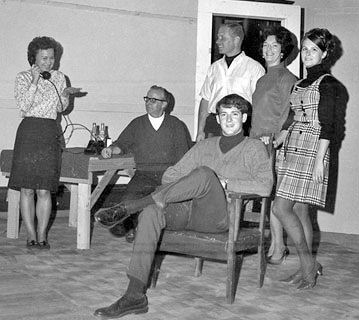
Vicki Rowell, Wayne Hicks, Gene Livingston, Barbara Rann, Alyce Duski-Cramer and seated is Phil Anderson.
They were upstairs in what was then the E. F. Boron Co. building practicing their roles in the play, “Come Blow Your Horn.” This was Neil Simon’s first play on Broadway and was later made into a film starring Frank Sinatra.
Thanks to Gene and Carol Livingston for the information.
Benny and Jessie’s Pet Info – New Rabies Guidelines Published
Do you think rabies has nothing to do with you and your dog or cat? You’re wrong. While the disease itself is now (thankfully) quite rare in people and pets in the United States, it is still extremely important.
A new edition of the Compendium of Animal Rabies Prevention and Control has just been released and it contains some updated recommendations with regards to protocols to be followed when a pet bites a person or when a pet is bitten by a rabid or potentially rabid animal. To paraphrase:
Regardless of rabies vaccination status, a healthy dog or cat that bites a person should be confined and observed daily for symptoms consistent with rabies infection for 10 days from the time of the exposure.
Dogs and cats that have never been vaccinated and are exposed to a rabid animal should be euthanized immediately. If the owner is unwilling to have this done, the animal should receive a rabies vaccination and be placed in strict isolation for 4 months. Isolation in this context refers to confinement in an enclosure that precludes direct contact with people and other animals.
Dogs and cats that are overdue for a booster vaccination and without appropriate documentation of having received a USDA-licensed rabies vaccine at least once previously should be treated as an unvaccinated individual. Alternatively, the dog or cat can undergo serologic monitoring for a response to rabies vaccination that indicates the animal has been previously vaccinated. If serology indicates no previous vaccination, the dog or cat should be treated as an unvaccinated individual. If serology provides evidence for a previous rabies vaccination, the dog or cat can be treated as an overdue but previously vaccinated individual (see below).
Dogs and cats that are overdue for a booster vaccination and that have appropriate documentation of having received a USDA-licensed rabies vaccine at least once previously should receive a booster rabies vaccination and be kept under the owner’s control and observed for 45 days.
Dogs and cats that are current on rabies vaccination should receive a booster rabies vaccination and be kept under the owner’s control and observed for 45 days.
The Compendium holds a lot of sway, but it is not the definitive word on what happens to a dog or cat after biting a person or after exposure to a rabid animal. Those decisions are made and enforced at the state and local levels. A new website under development, RabiesAware.org, will provide owners and veterinarians with a lot of good information, like state-specific answers to the following “frequently asked questions” about rabies:
– Which species are required to be vaccinated against rabies?
– Who is legally authorized to administer a rabies vaccine?
– What are the medical record requirements for rabies vaccination?
– What are the age requirements for rabies vaccination?
– Following the initial rabies dose, when is an animal legally immunized?
– What are the state importation requirements for rabies vaccination?
– Can a 3-year rabies vaccine be substituted for a 1-year vaccine?
“Overdue” for rabies vaccine booster
– Can a rabies antibody titer be used to establish “immunity?”
– What constitutes rabies “exposure” in a pet?
– What are the consequences of rabies “exposure” in a pet?
– What are the consequence for a pet that bites a human?
– Can a veterinarian exempt rabies vaccination requirements?
– At what age can rabies vaccination be discontinued?
– Is rabies vaccination of hybrid species recognized or allowed?
Maralyn’s Did You Know? – Fromm Family Pet Food Recall
Fromm Family Pet Food, a Wisconsin-based pet food company, is recalling select 12. Oz cans of Gold canned dog food pâtés due to possible issues concerning elevated levels of Vitamin D.
Fromm Family Pet Food discovered the issue through their own analysis and, according to a letter found on its website, is,“recalling these products out of an abundance of caution.”
The following cans of Fromm Family Pet food, which were distributed from December 2015 to February 2016, are part of the recall:
12 oz. Gold Chicken Pate Dog can case code#11893, individual can upc : 72705 11892
12 oz. Gold Chicken & Duck can case code #11895, individual can upc: 72705 11894
12 oz. Gold Salmon & Chicken Pate can case code #11891, individual can upc: 72705 11890
Fromm Family Pet Food has yet to receive any reports of any health problems associated with these cans. According to company, “the impact of the excess Vitamin D should be seen only when dogs have eaten these products as their exclusive meals for an extended period of time.”According to the company, this could lead to a reduction in appetite.
If you have any of dog food cans involved in this recall the company urges you to return them to the place of purchase or any Authorized Fromm Retailer for return to Fromm Family Foods. To find an Authorized Fromm Retailer near you, visit frommfamily.com/retailers or call (800) 325-6331.
For additional information about the recall contact Fromm Family Pet Foods at (800) 325-6331.
Letters – Did you know?
I was appointed, several months ago, to MSU Extension and AgBioResearch State Council. I represent the counties of Barry, Clinton, Eaton, Gratiot, Ingham, Ionia, and Montcalm. It is a diverse and large district.
I thought I would tell you just some of the interesting facts that I have learned.
MSU Extension and AgBioResearch have many on campus labs along with 13 off campus research centers. Every dollar that the state invests into MSU Extension leveraged an additional $2.06 in federal funds, contracts, grants, and other revenue. This included $1.3 million leveraged for children and youth programs.
MSUE has one hundred years of history with regard to making community connections and using their expertise in addressing/educating people on health related issues.
When taking part in a natural shoreline preservation program I learned that by rebuilding and taking care of shorelines, the results can be amazing. There will be increased privacy, reduced noise, less pollutant run-off, natural deterrents for geese, and support toward native plants and animals. All seem like good consequences.
The Red Pine is the most widely planted commercial forest species in Michigan occupying more than 25,000 acres.
Michigan Milk Producers donated 22,700 gallons of milk to MI Food Banks. Most recently they donated 12,000 gallons to Flint! The cost/human benefits of this action are huge. There are, and have been, 15 MSUE/Ag Bio Research staff living and working in Flint, including several health scientists. Check out the Empower Flint APP.
Michigan is number one nationally in the production of blueberries, tart cherries, and black beans. Number two in dry beans. Number three in apples. Number four in sugar beets. Ninth in potato production and thirteenth in winter wheat.
The programs available through MSU Extension and AgBioResearch are plentiful and everywhere in this state. Visit www.msue.msu.edu for more information.
Lynn Mason,
Belding Area Resident
Maralyn’s Pet Corner – Why Do Cats Eat Grass?
Whether you have an indoor or outdoor cat, one thing is for certain: your feline friend has probably nibbled on grass on more than one occasion. While it might seem like strange behavior — especially when your cat throws up afterwards — there’s really nothing to worry about. Not only is there no evidence to suggest that grass will harm your cat, but many experts theorize munching on those long green blades can be beneficial for your cat.
Carnivorous Rex
Cats regurgitate when they eat grass because they lack the necessary enzymes to break down vegetable matter. Does this mean your cat likes to throw up? Well, while it’s doubtful that kitty enjoys the act, this up-chucking sensation may eliminate all indigestible matter from the cat’s digestive tract, making it feel a whole lot better. This is important because cats eat their prey as is, including both the edible and inedible parts (fur, bones, feathers, etc.)
It’s in the Juice
Much like mother’s milk, the juices in grass contain folic acid. This is an essential vitamin for a cat’s bodily functions and assists in the production of hemoglobin, the protein that moves oxygen in the blood. Think of it as a wheat grass shake for your kitty (let’s hope they like it more than you do).
Nature’s Laxative
Another theory is that grass acts as a natural laxative, counteracting any cases of indigestion. As any cat owner knows, cats regularly throw up and leave lovely, wet little fur ball presents around the house. But when the fur moves deep into the digestive tract, kitty needs a little help to break it down and pass it out the other end. Call it a sixth sense or just intuition, but your cat knows that a little bit of grass may just go a long way in cleaning out its system (and may save you a trip to the veterinarian).
So all in all, ingesting grass is not a bad thing. Some even believe cats eat grass to relieve sore throats. We would like to point one thing out, though. Regardless of whether you have an indoor or an outdoor cat, you should make sure that all your household plants are of the non-toxic variety. You may also want to buy a small tray of grass just for the cat, or start an herbal home garden. This will give your cat an alternative to the outdoor grass and landscaping, the eating of which could lead to accidental ingestion of pesticides, herbicides, or chemicals that may have been used to treat your (or your neighbor’s) yard.
Remember When? – Glaspie Drug Store
by Maralyn Fink
Back in my day this building which is now a dance studio was Glaspie Drug Store. The store was operated by Harold Millman who was also the Pharmacist. I loved going in just smell the compounds and chemicals.
Harold’s wife was Elizabeth Millman, and they resided at 305 E. Walker St. Mrs Millman was head of Bement Public Library. In my eyes at that time, they lived in a huge “mansion”. It was a very beautiful place, and I used to wonder what that would be like.
In high school when we had co-op, which meant we left the last hour of school to work at a job. I worked under Mrs. Millman in the children’s library in the basement. I remember the basement was always the hottest place to be, and at times I caught myself in a doze.
There were 3 Pharmacies back then, and Mr. Millman was one super person giving great customer service. If I could only go back!