Clinton Ophthalmology
by Maralyn Fink
I attended the open house of Dr. Brandy Cook, DO at her new location at 1000 E. Sturgis #3 in St Johns.
Dr. Cook recently moved from Avery Vision for the purpose of more room for her equipment and more space in general.
She specializes in cataract surgery, eyelid surgery, surgical procedures, laser treatment, diabetic care and emergency eye care, in-office treatment and routine eye exams.
There are 3 exam rooms, one being close to my heart, a handicap room with a chair that moves forward, backwards making it easier for the patient to get into the chair.
Office hours are Mon-Tues 8am-5pm, Wed. 9:30-5pm, Thurs-Fri. 8am-5pm. The phone number is 989-224-1452.
I noticed a food spread for guests, so I needed to check that out. Maybe some cookies. Oh yes, there they are just waiting for me. It’s been a dry spell, ya know.
Thank you Dr. Cook, Todd, Taylor and Brayden along with the staff for the tour and the interview and answering my questions.
Please feel free to call Dr. Cook’s office for more information or to make an appointment.
This week’s Mystery Photo
Where is this?

Can you tell us where this is located? Drop us a line at mail@sjindy.com.
Jonathan Pulling writes, “It is located at 304 East Walker Street.”

This is one of the houses built by Dr. S. R. Russell. The current owners are William and Janet Russell. Previous owners include Edith Russell and Lyle and Maureen Canum.
A Look Back – Newlyweds Involved in Accident
by Barry Bauer
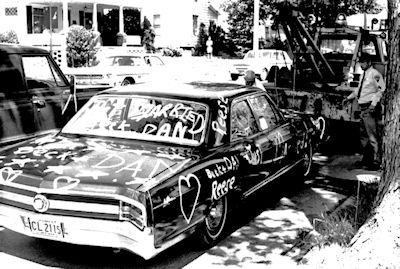
In 1971 a northern Michigan honeymoon for an Angola, Ind. couple was ruined Sunday morning when their car collided with another vehicle causing a chain reaction three car pile up. The couple, newlyweds Mr. and Mrs. Daniel J. Reese, were not hurt, but their car was badly damaged. Others involved were Richard Piske and John Norton of Albion. They also escaped injury in the US-27/M-21 mishap.
St. Johns Police Officer, Robert Ott (right), looks on as wrecker operator hooks up the newlywed’s car.
Maralyn’s Did You Know? – Remember to leave Michigan’s wildlife in the wild
With spring in full swing, Michigan residents may be noticing an increase in sightings of nestlings and baby animals. For example, baby cottontail rabbits and raccoons are a common find this time of year. The Department of Natural Resources reminds those who stumble across a nest of baby bunnies or see other baby wildlife to please leave them be. Leaving wildlife in the wild is best for humans as well as animals.
“Animals are better left alone than removed from the wild,” explained DNR wildlife technician Hannah Schauer. “A nest full of young rabbits may look helpless, but staying in the nest is their best chance for survival. However, we appreciate the good intentions of those who want to help.”
If a rabbit’s or other animal’s nest is found, it’s important to also keep children and pets away. If the nest is left alone, the mother will likely return when she feels it is safe.
Every day an animal spends with humans makes it less likely to be able to survive in the wild. Animals that are habituated to humans generally do not do well when released back into the wild.
raccoon in treeFor your safety – do not take a wild animal from the wild. For example, raccoons may seem cute, especially when they are young, but they are well-known for becoming aggressive as they get older. Wild animals can act unpredictably, even if they seem tame. It is important to remember they are still wild animals and can seriously injure a person or pet.
Additionally, raccoons and other wild animals can carry diseases and parasites that can infect humans and pets. Whether an animal may be a carrier of a disease or parasite cannot be determined simply by observing it’s physical appearance.
Only licensed wildlife rehabilitators may possess abandoned or injured wildlife. Unless a person is licensed, it is illegal in Michigan to possess a live wild animal, including raccoons and rabbits.
The only time a baby animal may be removed from the wild is when it is obvious the parent is dead or the animal is injured. A licensed rehabilitator must be contacted before removing an animal from the wild. Rehabilitators must adhere to the law and have gone through training on the proper handling of injured or abandoned wild animals and will work to return the animal to where it will have the best chance for survival.
A list of licensed rehabilitators can be found by visiting mi.gov/wildlife or by calling your local DNR office.
Letters – Reader wonders about the old mint still
My name is Judy Winslow, and I keep wondering about the old Crosby mint building on old US-27 and just north of Parks Rd.
Is there any way that it can be saved for the history of St Johns? I would gladly do what ever can be done to help with it.
I have made a few phone calls but can’t get any help.
Please contact me at judyelain2015@hotmail.com