Laurenza Riojas recalls 32 Years in MSU Student Affairs
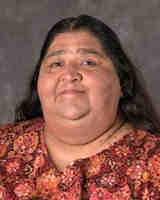 [Editor’s note] Laurenza Riojas attended St. Johns High School and studied psychology at Michigan State University. Here she is being interviewed by the website http://servicelearning.msu.edu/
What is your current role at MSU at how did you get here – what’s your “career story”?
My current role is Informational and Statistical Analyst. I work with databases and survey information. I also coordinate transportation for some of the service-learning students. I have been with the CSLCE since 1997 and until 2015 I was an office manager. I came to the Center after being a secretary in the Office of Judicial Affairs for 14 years. I have been with MSU and in the Student Services Building for 32 years.
In addition to her statistician duties, Laurenza coordinates transportation and manages six drivers to help Service-Learning students to get to area schools
How do you describe your job to your friends and family?
To my friends and family, I describe my role as a database and data manager – I rarely give my title, because people always ask what that means. I also tell them I coordinate transportation and manage six drivers for some of the Service-Learning students to get to area schools and community centers, because that is a big part of my job. (Editorial note: I often think of this part of Laurenza’s job almost like that of an air traffic controller – coordinating lots of moving parts while moving students all across Greater Lansing!)
What do you like best about your job / position at MSU?
The best thing about my job at MSU has always been the people with whom I work, both on and off campus – students and community partners. I also love the growth in technology and how far we’ve come in the 32 years I’ve been on campus. I started out with an electric typewriter and I remember the data reports we worked on back then and how they compare to what we can do now. We’ve come a long way!
What is your favorite quote?
“Keep looking up, that’s the secret of life . . .” -Snoopy
What in your life makes you happy or are you most proud of?
My family life makes me the happiest. I’m so proud to be a mom and wife. My family came together by way of adoption and through marriage. We have seven children all together: two girls and five boys and one granddaughter. Five of the children still live at home.
Courtesy of CSLCE – November 29, 2016
This week’s Mystery Photo
Where is this?

Can you tell us where this is located? Drop us a line at mail@sjindy.com.
704 N. Clinton Ave.

The current owner is Sara Geller. Previous owners include Michael Galvach, Dorothy Knight, Dean Mazzolini, Richard Brunner, Estella Boak, Patrick and Pamela Walsh.
A Look Back – Jaycettes
by Barry Clark Bauer
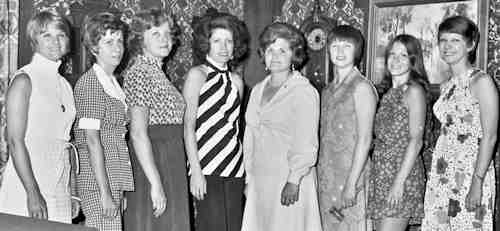
This group was elected Jaycette officers in 1974.
3rd from left is Diane Evitts Sharick, 5th from left is Janet Martin Scott, and 6th from left is Diana Sillman Woodbury.
The remaining ladies are unidentified.
Benny and Jessie’s Pet Info – Retractable Leashes: Are They Dangerous?
Once you have bought the items that’ll make your furry new family member feel welcome in your home—like beds, treats, and toys—it’s time to make decisions about practical things—like which leash you will use for walking with your canine companion.
There are the traditional leather or nylon leashes, which come in enough colors and lengths to suit any pet owner’s style, and there are retractable leashes, which also come in a host of different styles to suit individual preferences. The main goal, however, should be to choose the safest leash for your dog.
While it can be said that there are pet owners who are happy with their retractable leashes, before you make that final decision, consider the pros and cons of these devices.
The Pros of Retractable Leashes
Some dog owners prefer using a retractable leash over a standard leash when walking their pup. For Josh Manheimer, a direct mail copywriter for J.C. Manheimer & Company in Vermont, using a retractable with his 2-year-old basset hound Stella makes sense so she can still explore all the smells she wants.
“The benefits of extending leads are clearly that dogs can have more interesting walks and poorly trained dogs can still be prevented from running off and into danger,” says Dr. Roger Mugford, animal psychologist and CEO and founder of the Company of Animals.
There are benefits for both the dog and the human walking them, says Phil Blizzard, CEO and founder of ThunderWorks, which makes a retractable ThunderLeash. In addition to exercise, Blizzard says a retractable leash allows the human to keep a steady pace while the dog can freely sniff things that interest them.
The Cons of Retractable Leashes
The main drawbacks of retractable leashes revolve around training and safety.
Blizzard realizes that retractable leashes can be a safety concern. To help this, the ThunderLeash comes with a booklet to help dog owners use it more safely. The ThunderLeash can also be arranged to be a “no-pull” leash, wrapping around the dog’s torso to discourage pulling, says Blizzard.
“You need to be paying attention if you have the retractable on the open setting where it can go to the full length,” he says. “If you’re in the city you need to make sure you’re keeping your dog on the sidewalk, out of danger, and not running up to somebody. It’s not a good multi-tasking device as they’re currently designed.”
Manheimer says he hasn’t had any issues while walking Stella, but he’s still cautious. “My biggest concern is if Stella absentmindedly wanders after an attractive scent, or worse, lunges for a squirrel.” Cars are another issue, he says. “Neither of us is aware of the stealthy Prius in electric-mode.”
Safety Factors to Consider with Retractable Leashes
Not all pets, or pet owners, are good candidates for retractable leashes. Veterinarians say they see a lot of injuries related to retractable leashes.
“The most common are neck injuries, since a pet might start to run before the owner can lock the leash,” says Dr. Duffy Jones, DVM, of Peachtree Hills Animal Hospital in Georgia. “Many times the dogs have a full head of steam before the owner locks the leash, so it creates a good deal of force on their collar when the leash finally locks.” Reports of lacerated tracheas (windpipes) and spinal injuries are relatively common.
Other injuries include dog fight injuries due to a dog being too far away for the owner to bring it back quickly enough, and although Jones says never treated a dog that’s been hit by car due to a retractable leash, he says it’s easy to see how such things can happen.
“A few years ago I was driving home in my neighborhood after dark and I saw a man walking on one side of the street,” he says. “As I got closer, I realized his dog was on the other side of the street with a retractable leash. Luckily, I was able to stop to allow him to retract the leash and get his dog back on the same side of the road as himself.”
And it’s not only pets that can be injured by a retractable leash, humans can be injured by getting wrapped up in a long leash and falling, Jones says.
Mugford says that some of the safety issues with retractable leashes come because people don’t know how to use them properly.
“Too often, people don’t get the hang of thumb controls, and they panic and lose control of the dog,” he says. “Owners reach forward to grab the line of the extending lead with their free hand and can then sustain nasty rope burns.” In one case that received attention a few years back, a woman had her index finger cut off by a retractable dog leash.
It’s clear that leash manufacturers understand that retractable leashes come with safety concerns.
Mugford’s company makes the HALTI Walking retractable lead, which he says alleviates the rope burn problem with soft tape. The company also takes safety into consideration with reflective thread in the leash and an ergonomic handle.
Another retractable leash manufacturer, flexi, offers written directions and a video on their website so owners will better understand how to use retractable leashes. The directions cover possible safety issues like falls, face injuries, and finger amputations, and tells people how to avoid these dangers.
How Retractable Leashes Affect Training
Even if you’re committed to using a retractable leash while walking, you may want to reconsider it if you’re looking to train your dog, trainers say.
“As a trainer, one of the biggest things I see people coming in for is loose-leash walking,” says Merritt Milam, founder and head trainer at Wags ‘n Whiskers in Alabama. “It’s what everyone’s worried about, but a retractable leash literally teaches a dog to pull.”
If you want to train your dog for loose-leash walking but have been using a retractable leash with your dog, Milam says it’s harder to reverse the behavior. It’s also difficult to train other behaviors while using a retractable leash because the dog is so far away.
“If they’re four to six feet away, they’re still in your vicinity and you can talk to them and give them cues as you need to,” she says. “[Retractable leashes] might not teach them to ignore, but it gives them the opportunity to ignore as much as they want.”
Instead of retractable leashes, Milam recommends a four-to-six foot flat leash. “Just a regular leash that’s not going to let them drag their owner 15 feet, that’s my favorite.”
She uses longer leashes for training sometimes, such as a 20-foot leash, but notes that she can make them shorter if necessary and isn’t relying on a button to do so, like on a retractable leash.
Even dogs who are used to walking with a retractable leash can learn loose-leash walking, Milam says. “It just takes more time and patience.”
Overall, there are clearly concerns about retractable leashes when it comes to both training and safety. If you have specific questions, talk to your veterinarian or trainer to see which option will work best for your dog.
Letters – Giving Thanks and a reader needs genealogy help
Dear friends of the Community Thanksgiving Day Dinner,
This year our feast included 80 people of all ages and walks of life. It was a good chance to share a little time together and make new friends, too. In our busy time of history, it now seems to be a rare thing to stop and make a grand meal from scratch and then to relax in the company of people we know, as well as those we do not yet know. Something special happens when you share a meal with others and most everyone who came sensed that.
So we want to thank you for your part in bringing the feast together this year. Donations over $200 came in to support the work of Basic Needs Center downtown, who also came by Friday to gather the things we did not serve for others to enjoy the delicious food. Our promotional effort was not as energetic as 2015 and so the number of diners and volunteers together was less than last year. In debriefing our steering committee decided to reach out to our donors and volunteers so they, too, can make personal invitations to more people so the goodness can be shared more widely.
Guven Witteveen
My name is Patricia Miller. I was raised by David and Catherine Felzke and for a time in the homes of Mary Joann Gunther and Gary and JoEllen Teegardin. My Grandmother was Patricia Zerba. I am trying to do our geneology but have met wall after wall.
I was born on August 17, 1968 in Sparrow Hospital of Lansing Michigan.
My family live in Hubbardston and the surrounding area now. I have a brother in Arizonia as well. The Dad who adopted me lives in Ionia.
I did send the same type of e-mail to the Celtic Path in Hubbardston because I was told that is the Historical Center there. A man told me today that I need to contact a 72 year old man named Jim Wohlfert for answers. I cannot find his phone number. The two phone numbers posted online are disconnected.
Can anyone direct me to a historian that can shed more light on this for me?
Sincerely,
Patricia Miller
(724)355-0505
P.O. Box 246
Connoquenessing, PA 16027
Patricia F. Miller on Facebook