Chad Rehmann works on new arrangements
This past year Chad Rehmann has been working with the amazingly talented Lisa Dondlinger on her upcoming album. Last year she released her first video, an arrangement that he did of Holst’s Planets and Horner’s score for Braveheart.
She will be releasing a new video with one of their newest arrangements soon. For more information check out http://www.lisadondlinger.com/music
Chad lives in Los Angeles with his wife Kari (Wieber) Rehmann and their three children.
This week’s Mystery Photo
Where is this?
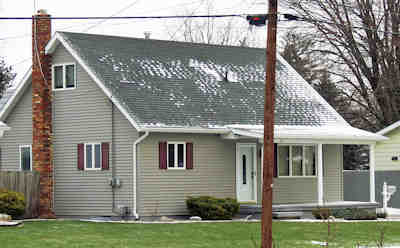
Can you tell us where this is located? Drop us a line at mail@sjindy.com.
110 West Steel

Jody Brown writes: My husband and I lived (daughter-Laci) in this beautiful home for 23 ½ years. Loved the neighborhood, wonderful friends and great memories. Sold it to Joe and Jessica Gazda when we retired and moved to northern MI. We purchased this home from Jim and Jean Archambault. The address is 110 West Steel Street.
Barry adds: The current Owners are Joe and Jessica Gazda. Previous Owners include James Archambault and Richard and Jody Brown.
A Look Back – Mural
Barry Clark Bauer

This 1971/1972 photo shows a mural that used to hang in the Clinton National Bank & Trust building on the wall behind the cashiers. It depicts life in St. Johns, both city and rural, in the 1950s.
Later on the Bank donated the mural to the City and it was hung in the old Municipal Building where this photo was taken. When the new Courthouse was completed the mural was moved to a conference room there where it can be seen by visitors today.
Benny and Jessie’s Pet Info – Why You Must Vaccinate Against Parvo
Parvovirus is a threat to American companion canines for a variety of reasons. It’s a disease capable of causing fatal illness, making it very challenging for veterinarians to treat and costly to owners. Fortunately, infection with parvovirus is preventable provided owners adhere to veterinary recommended vaccination schedules along with following precautionary lifestyle practices.
What is Parvovirus?
Parvovirus, commonly known as “parvo,” goes by the full name canine parvovirus type 2 (CPV2). Parvovirus is not limited to canines, however. It is capable of infecting multiple species, including wildlife like foxes, coyotes, raccoons, skunks, and wolves. Cats can be infected by parvovirus’s relative: feline panleukopenia virus (FPV). Humans are not at risk for infection.
How Does Parvovirus Infect its Host?
Parvo spreads when viral particles are shed in the feces, and potentially via other bodily substances like saliva and vomit, of an animal that is harboring the virus.
When a dog that has deficient immunity to parvovirus comes into oral (mouth) contact with these infected bodily substances, or with contaminated surfaces containing the virus, the viral particles move to the lymph nodes at the back of the throat and begin their attack on the immune system, replicating inside the white blood cells called lymphocytes. Through the bloodstream the virus reaches the bone marrow, where it interferes with the production of white blood cells, and into the digestive tract, where it damages the inner lining of the intestines.
Three to seven days are required for the virus to incubate inside the body before clinical sings appear. Signs include:
– Lethargy
– Loss of appetite and water consumption
– Vomit
– Diarrhea
– Elevated (fever) or decreased body temperature
Vomit may contain food, water, bile, or other substances labored in the stomach and can be continuous even if the dog hasn’t eaten. Diarrhea tends to have a soft to liquid consistency and explosive quality and can contain mucous or be red-tinged. The severe damage caused by the parvovirus to the intestinal lining results in a distinctive foul smell from the colon shedding its lining. The combination of vomiting with diarrhea can lead to critical dehydration.
With the intestinal lining under attack, the normal bacteria that inhabit the intestinal tract can cross into the blood stream, overwhelm the immune system’s ability to produce white blood cells, and cause a condition called sepsis.
How is Parvovirus Treated?
Due to the severe nature of the clinical signs and course of disease associated with parvovirus, in-hospital treatment is necessary to limit the potential for other dogs to become infected.
Parvovirus is primarily treated in-hospital with fluid therapy, antibiotics, antacids, anti-nausea drugs, blood product transfusion, probiotics, and other treatments. Medical quarantine in an isolation area of a veterinary hospital helps keep the virus contained to a limited space that can be disinfected after a patient is discharged.
The extensive nature of the treatment can limit a family’s financial ability to put a canine companion through treatment, which is why I suggest owners follow all preventive recommendations and purchase health insurance early in a dog’s life.
How is Parvovirus Prevented?
Prevention is the best treatment when it comes to parvovirus. Fortunately, a vaccination exists that is capable of stimulating the immune system to produce an antibody response which confers a protective level of immunity.
Since parvovirus is an infectious agent that is capable of causing life-threatening disease, and the vaccination reliably produces antibodies sufficient to provide protection, it is considered one of the “core” vaccinations, along with distemper and rabies vaccines.
The parvovirus vaccine is not a legally required vaccine, but all dog owners are obligated to do their best to protect their canine companions from life-threatening ailments; following veterinary recommended core vaccination protocols is an essential duty.
Unvaccinated puppies and adult and senior dogs that lack sufficient immunity to parvovirus are generally more susceptible to the disease than satisfactorily-vaccinated adult and senior dogs. Yet, even appropriately-vaccinated canines can be at greater risk for contracting parvovirus when they have a disease that compromises their immune system, such as Immune Mediated Hemolytic Anemia (IMHA) and Thrombocytopenia (IMTP) or cancer. This is also true for those taking immunosuppressive drugs (chemotherapy, etc.), and for those that are in contact with unvaccinated dogs (shelters, boarding, etc).
The Best Age for Dogs to Get the Parvovirus Vaccine
When puppies are born they have residual immunity from their mother; that immunity starts to wane over the weeks after they are weaned (no longer nursing) from their mother’s milk.
For this reason, dogs generally start their puppy series of parvovirus vaccinations around six weeks of age, as vaccines given earlier in life when nursing is occurring may be less effective due to maternal antibody interference.
The parvovirus vaccine can be given as a single vaccination agent, but it’s commonly combined with the vaccines for distemper virus, adenovirus, and parainfluenza virus.
Generally, parvovirus vaccinations are given every three to four weeks until three or four have been given. Performing a blood test called an antibody titer two to three weeks later can determine if a sufficient immune response to parvovirus has been produced or if a booster vaccination is needed.
Two to three weeks are required for a puppy to mount a sufficient immune response to a vaccination, so as vaccine-induced immunity is forming it’s crucial to prevent exposure to canines of unknown vaccination status; this includes those recently in the shelter system, any dog showing clinical signs of an illness, and locations where other dogs congregate (daycare, dog parks, etc.) or defecate (common elimination areas on city streets, etc.). For both health and hygienic reasons, these rules should still apply after the vaccination series is complete.
Maralyn’s Pet Corner – 5 Tips to Keep Your Senior Cat Healthy
A senior cat has different health requirements than a younger cat. Here are a few tips to help you keep your senior cat healthy.
1. Don’t Forget the Health Check-ups for Your Cat
Make sure your senior cat has regular visits with your veterinarian. In fact, many veterinarians recommend that senior cats should be examined twice a year, even more so if your cat has serious health issues. A thorough physical examination by your veterinarian may reveal health issues that can impact your cat’s life and comfort level, such as dental disease, arthritis, heart disease, kidney disease and more.
2. Note Any Behavior Changes in Your Cat
Watch your senior cat’s behavior carefully. This is important for all pets but doubly so for senior cats. Changes in your cat’s behavior may be a symptom of disease. Watch specifically for changes in your cat’s appetite and water consumption. Watch for changes in urinary and bowel habits and alterations in sleep routines. If your cat suddenly becomes irritable for no reason, it may be because he is in pain, having difficulty seeing, or having a hard time hearing properly. Any changes in your senior cat’s routines or behaviors should prompt a consultation with your veterinarian.
3. Make it Easier for Your Cat to Get Around
Be aware that your senior cat may have pain caused by arthritis or other health issues that make it difficult for him to get around as well as he did when he was younger. Consider providing ramps or stairs to allow your senior cat access to furniture or beds. Ramps on stairs may make it easier for your pet to get up and down the stairs, and carpeting on slippery floors may help your dog gain his footing. A litter box with lower sides can make it easier for your cat to get in and out of the box, and an extra litter box in another part of the house can help to prevent accidents.
4. Choose an Age-Appropriate Diet for Your Cat
Dietary requirements may change as your cat ages. It’s important that you provide your senior cat a pet food that is age appropriate. Some older pets tend to gain weight and may need a diet for less active cats. Others may have difficulty holding their weight and may need a diet with a higher calorie content or better palatability. Older cats also may have diseases that can be manipulated and/or controlled at least partly through diet. Your veterinarian can help you choose an appropriate diet for your senior cat based on cat’s individual nutritional requirements.
5. Pimp Out Your Cat’s Bed
Provide soft blankets and towels for your senior cat’s bed. This will help him to rest easier and sleep better. There are even special orthopedic beds made for senior cats. In addition to having a denser form to help cushion your senior cat’s aging joints, some orthopedic beds can be outfitted with a heat and/or vibration source, which increases circulation and reduces stiffness — perfect for dogs with arthritis.