This week’s Mystery Photo
Where is this?

Can you tell us where this is located? Drop us a line at mail@sjindy.com.
913 N. Oakland St.

The current owners are Roger and Janice Crowell.
A Look Back – Money Bags
Barry Clark Bauer
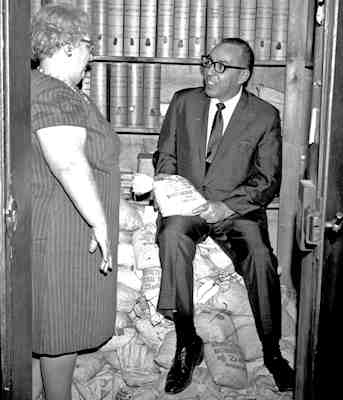

I was asked if I had this photo, and we’re in luck because I have an additional one!
That’s Velma Beaufore, Clinton County treasurer in 1968, giving a tour of the vault. The unidentified guy is sitting on money bags labeled, Michigan National Bank. I have no idea if the bags contained both money and checks or just money. There sure were a lot of them at what was probably tax time.
Benny and Jessie’s Pet Info – 5 Fast Facts You Should Know about Dog Saliva
Many of us don’t think twice about the saliva that comes out of our dog’s mouth when we lean in for a slobbery kiss. Affection between humans and their pets is not uncommon. However, what is common is the lack of education surrounding animal saliva, its bacteria, and how it impacts both humans and pets. Here are five fast facts about dog saliva that can change the way you think about your pet and its mouth.
1. Dog saliva helps prevent canine cavities. The saliva found in the mouths of dogs is better suited to prevent cavities, in comparison to human saliva.
“[Human saliva] has a PH of 6.5 to 7,” says Dr. Colin Harvey, emeritus professor of surgery and dentistry at the School of Veterinary Medicine at the University of Pennsylvania. “The saliva of dogs and carnivores in general is slightly alkaline, around 7.5 to 8. The significance of that difference is that dogs do not get dental cavities nearly as frequently as humans. The slightly alkaline nature of dog saliva buffers the acids that are produced by some bacteria that are the cause of the enamel of the tooth being eroded away.”
2. Saliva helps dogs with digestion, but not in the way you think. “There are no digestive enzymes present in the saliva of dogs,” Harvey says. “It is purely designed to get the food down into the stomach so the digestive process can start.
In fact unlike people, dogs don’t have to chew their food to mix in the saliva and start the digestive process. A dog’s stomach and intestines can do all the necessary work. The pure, simple function of dog saliva is to move food down the esophagus.
3. Dog saliva is antibacterial. “Dog saliva does contain chemicals that are antibacterial and it’s very unlikely that saliva by itself would be a direct cause of infection,” says Harvey. “You often see dogs licking wounds and that is a cleansing action and an antibacterial action to promote the healing of a superficial wound.” Of course licking won’t cure all superficial infections in dogs, so veterinary visits are still often necessary.
Dog “kisses” may transfer bacteria to humans. Just because dog saliva has antibacterial properties does not mean that dog “kisses” are clean and humans should let their guard down. Dr. Edward R. Eisner, the first veterinarian to become a board-certified specialist in Veterinary Dentistry in Colorado, notes that it’s possible for bacteria to be transferred from pets to humans. One study published in Oral Biology in 2012 found that there can be a transmission of periodontopathic species of bacteria between dogs and their owners.
4. Dog saliva may produce allergies in humans. While many people believe that pet fur is the culprit of allergic reactions to dogs, many of these allergies actually stem from proteins found in dog saliva. According to a study published in the European Journal of Allergy and Clinical Immunology, dog saliva contains at least 12 different allergy-causing protein bands. When dogs lick their fur, the saliva dries, and these proteins become airborne. Researchers who conducted the study concluded that dog saliva has greater potential as an allergen source than dog dander.
5. Tips for Preventing Periodontal Disease
Dr. Eisner notes that despite the cavity-preventing nature of dog saliva, periodontal disease will still occur without active prevention.
“Saliva coats our teeth,” says Dr. Eisner. “If it’s not brushed off by tooth brushing, it becomes plaque, which further traps the bacteria.” As the condition progresses, the bacteria can cause bone destruction in the tooth-supporting structures of the mouth.
“When a dog or even a person has a mouth that hasn’t been cared for, every time they eat, they get bacteria in the bloodstream,” Eisner says. “It’s a 20-minute transit through the bloodstream, and our immune systems, spleens and livers helps clean the blood. It’s no harm for the very healthy with a good immune system. But young animals and pets with serious medical conditions or autoimmune diseases are more susceptible to circulating bacteria.”
Dr. Eisner recommends annual dental care for dogs. A puppy should have his first exam at eight weeks of age. Dogs that have periodontal disease may need to visit their vet more frequently to monitor the progress of the condition.
Letters – Farewell to a friend
We have lost a very special member of our combined high school classes.
Jerry Struck passed away Christmas eve after a struggle with bad health; he has been cremated and will have a Christian funeral at Oxford Assembly of God church on January 24, at 11:00 am followed by a military ceremony at a national cemetery.
Jerry will be missed for his tireless work keeping our classmates together through the “No-Name” and helping plan reunions.
We all send our condolences to Ann and family. God Bless, and May he rest in peace.
Darwin Beaufore
[Editor’s note: We here at the St. Johns Independent are grateful to Jerry for some of his high school photography that he shared with us over the years. Here is a sample of some of his work.]


And we won’t forget Jerry’s look at Lester Lake’s Jewelry Store.
https://plus.google.com/photos/110845930262453987007/albums/6166589135685705249
Maralyn’s Pet Corner – Excessive Cat Sneezing and Nasal Discharge
Why is My Cat Sneezing?
Cats sneeze for many reasons; but if your cat or kitten sneezes a lot, you may start to worry that there’s something wrong. If sneezing is the only symptom your cat displays — i.e., no discharge from eyes or nose, good appetite, no change in behavior or activity level — then it is probably of no concern. However, when ocular or nasal discharge is seen, the cat may have a cold or upper respiratory infection.
Upper Respiratory Infection in Cats
An upper respiratory infection in a cat is more like influenza in people than like a cold because it can be very difficult to get rid of without medical help, especially in kittens, old cats, and those with chronic health problems. In some cases, it can prove fatal.
Cat Cold Symptoms
– Sneezing, especially occurring as “spasms” over the course of a few hours, or frequently over several days.
– Discharge from the eyes or nose; this may be watery, bloody, or thick and colored clear, yellow or green.
– Coughing or excessive swallowing (if there is drainage into the back of the mouth and throat).
– Lethargy (with or without hiding)
– Loss of appetite
– Fever
– Dehydration
– Raised third eyelid
Primary Cause
As with people, most colds start as a viral infection, followed by a bacterial infection.
Immediate Care and What to Give a Cat for a Cold
– Keep the eyes and nose free of discharge using cotton moistened with warm water.
– Warm canned cat food or meat flavored baby food to encourage your cat to eat.
– Provide plenty of fresh water for drinking.
– Do not try to give your cat any kind of medication without consulting your vet as many human medications can be toxic to cats.
– Any kitten, no matter how active, should be seen by a veterinarian at the first sign of a cold. However, if your cat refuses to eat or even move, it is urgent you bring the cat to a veterinarian immediately.
Diagnosis
Usually a thorough physical exam is sufficient to diagnose an upper respiratory infection. If your cat has become anorectic (refuses to eat), blood tests and possibly X-rays may be taken to see if there are complications developing.
How to Treat a Cat with a Cold
Using a vaporizer that produces warm moist air will help the nasal passages and sinuses to drain. To treat the bacterial component of the cold, your cat will require antibiotics. A viral infection, meanwhile, will usually be dealt with by the cat’s own immune system.
If your cat is not eating or is dehydrated, your cat will be hospitalized and put on intravenous fluids until he is eating on his own. B vitamins and appetite stimulants may also be used to help his appetite to return. If neither of these methods help with your cat’s appetite, he may need to be force fed for a while.
Other Causes
Polyps and foreign objects like grass awns—sharp grass seeds that can burrow into a pet’s skin—can cause symptoms similar to a cold, although the symptoms often start on one side and then spread to the other. Fungal infections such as aspergillosis can also cause similar symptoms.
Living and Management
Once your cat is discharged from the hospital, continue the antibiotics and vaporizer therapy as directed by your veterinarian. Also keep his face clean of discharge.
Making certain that your cat eats is just as important as complying with the antibiotic regimen. Cats that go without eating for even a short period are at risk for developing hepatic lipidosis, a condition involving the liver that is very difficult to reverse.
If the symptoms resolve only to return a few weeks later, chances are the cat does not have a cold. The symptoms may be related to one of the other possible causes listed above. Additional diagnostic work will be needed.
If your cat’s cold is due to a herpes virus infection (feline rhinotracheitis), he may have occasional recurrences of the symptoms. As with people, you cannot get rid of a herpes virus; all you can do is treat the symptoms when they appear.
Prevention
There are many viruses that can cause colds in cats. Two of these viruses can be very hard on your cat, even without the bacterial component: feline herpes virus, as already discussed, and feline calicivirus. Fortunately, there are vaccines available for these viruses. Be sure your cat receives the initial series of injections followed by regular boosters, as recommended by your veterinarian.